

Market Weekly · 2026-09-28—2026-10-04
2026-09-28—2026-10-04|A-share weakness concentrates sector returns among the leaders
Executive summary
Global equities diverged with a weak bias this week. Major A-share, Hong Kong and UK indices weakened, while the Nikkei 225 and Nasdaq Composite rose. All covered commodities fell, led by precious metals. A-share sector breadth failed to improve: only 29.0% of sectors rose, and the gap between leading sectors and the sector median widened to +3.73%, concentrating returns further among the leaders. Property continued to lead, while pharmaceuticals and biotechnology and some defensive sectors strengthened or climbed the rankings. Communications, electronics and machinery remained weak. Weak sectors overlapped with those whose turnover fell from last week, but strength did not generally coincide with turnover changes.
Comparing global equity markets
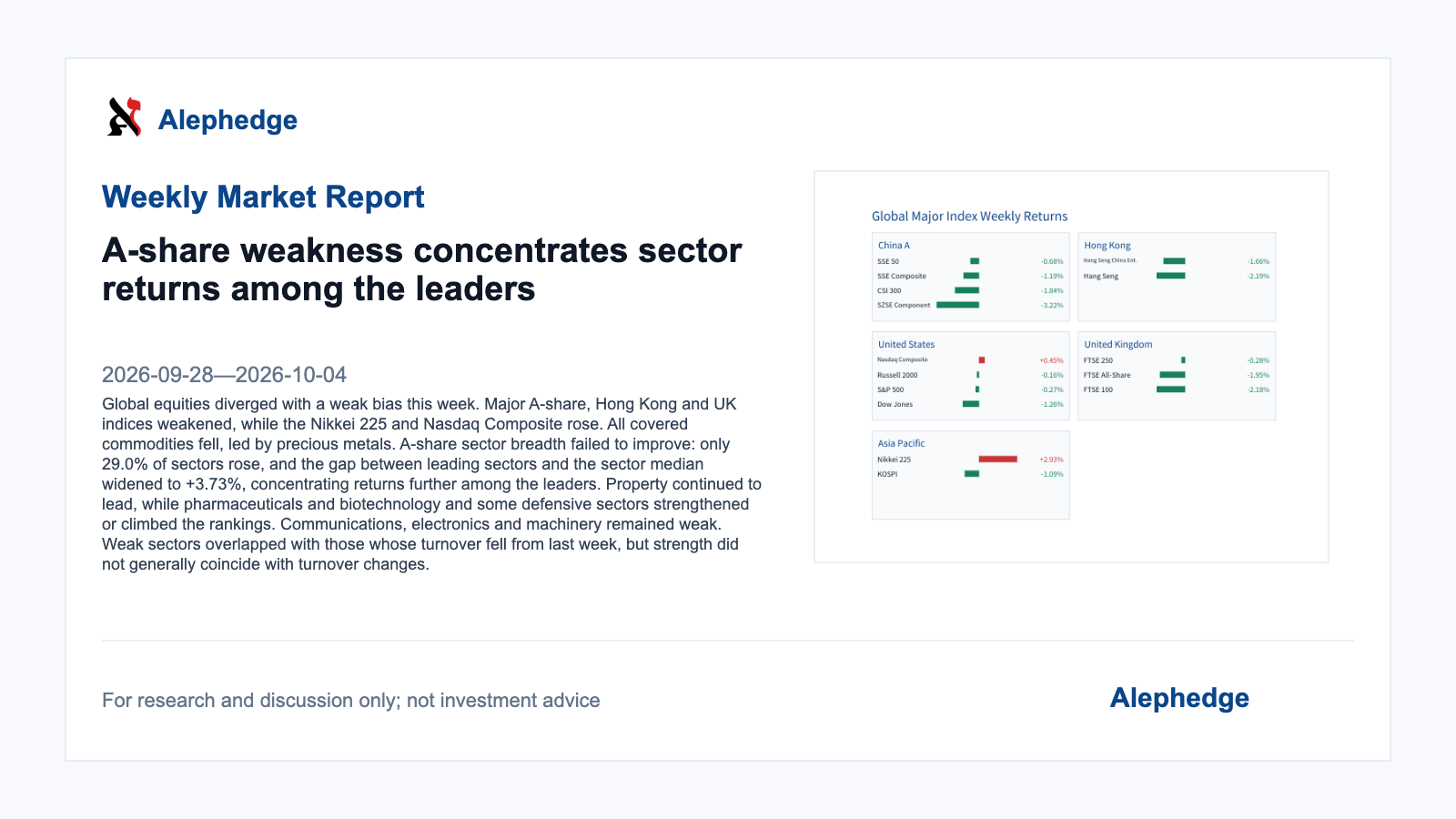
Major global equity markets diverged this week, with some rising and others falling. The Nikkei 225 rose +2.93% and the Nasdaq Composite +0.45%; the Shanghai Composite fell -1.19%, the CSI 300 -1.84%, and the Hang Seng Index -2.19%. The S&P 500 and Dow Jones Industrial Average fell -0.27% and -1.26% respectively. Markets did not move together, and major A-share indices weakened this week.
Commodity signals
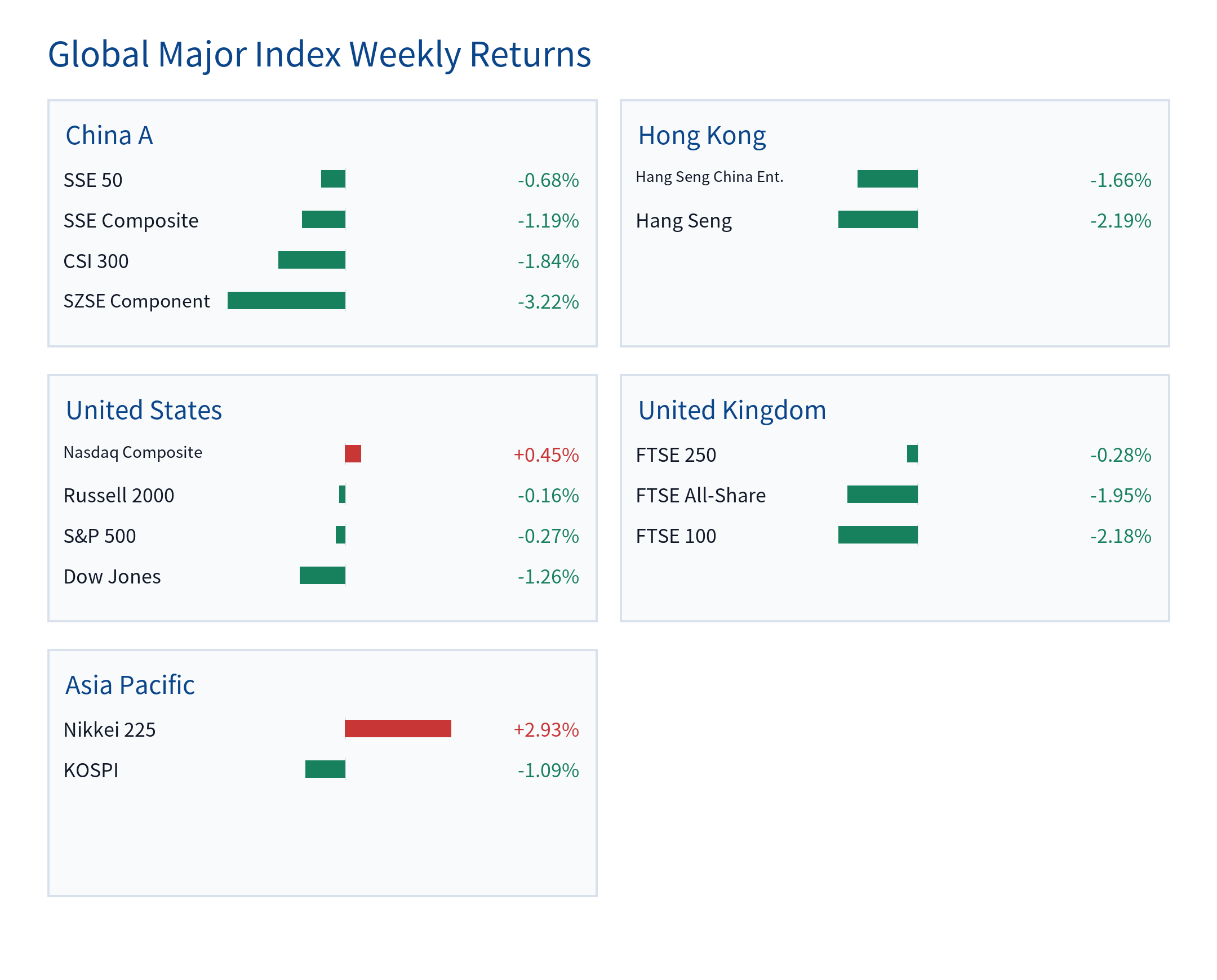
All covered commodities fell this week, with precious metals falling markedly more than Brent crude. Silver futures fell -6.64%, London spot silver -6.15% and gold futures -3.68%; Brent crude fell -1.98%. Commodities weakened overall, with a more pronounced retreat in precious metals.
A-share sector breadth, concentration and rotation
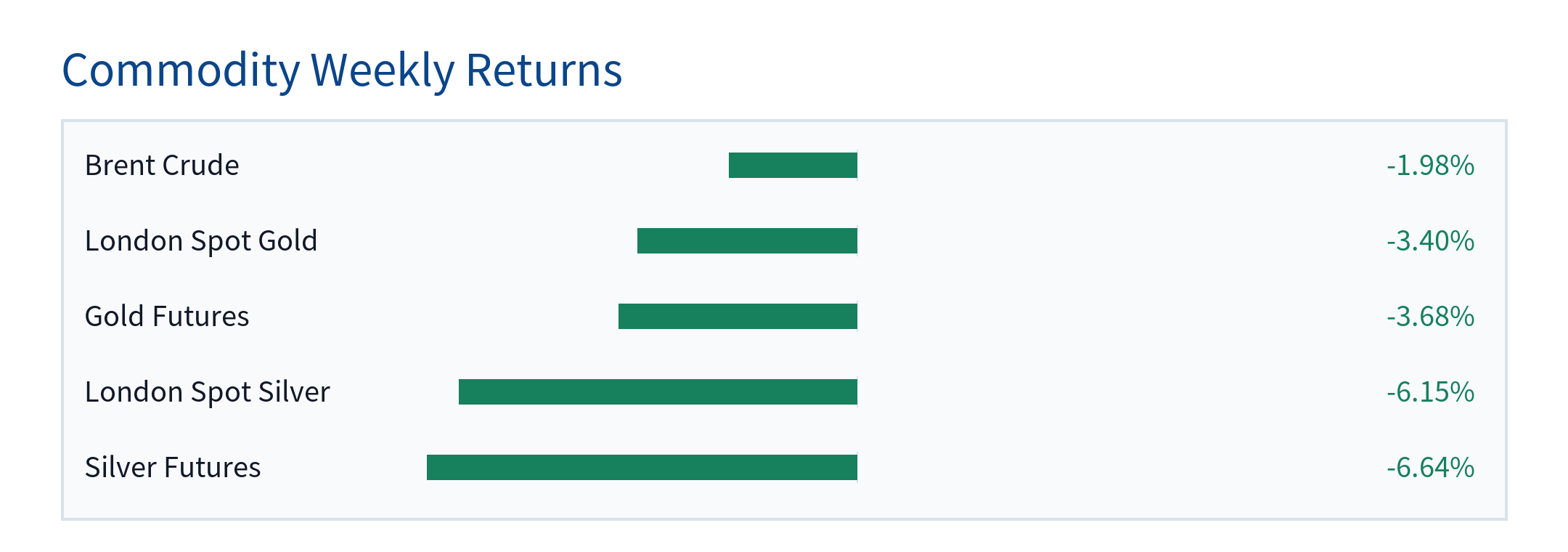
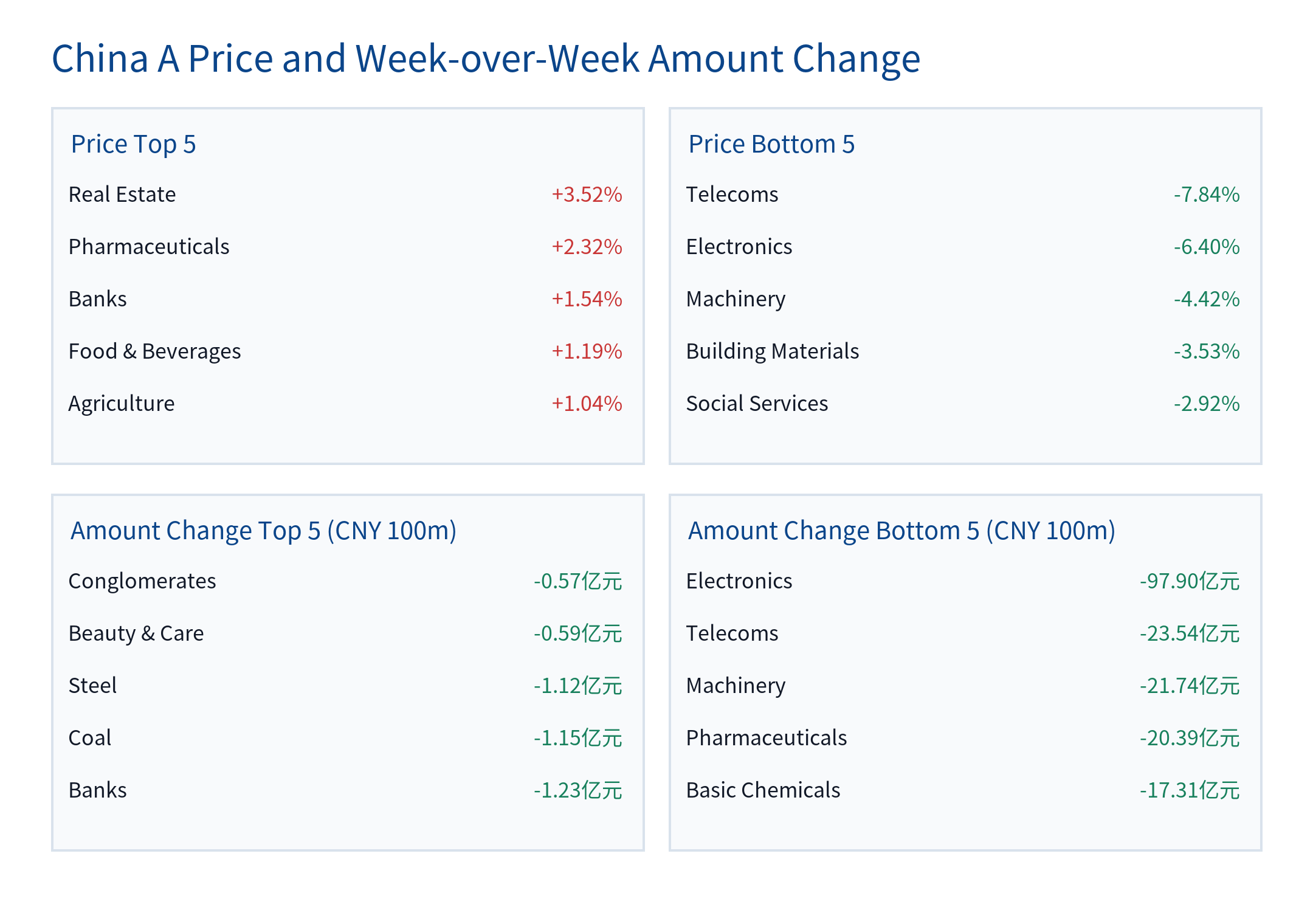
A-share sector breadth remained narrow and failed to improve from last week. Only 9 of 31 sectors rose, representing 29.0%, and 21 outperformed the benchmark, representing 67.7%; both proportions were unchanged. Leading sectors' average return was +2.46%, against a median sector return of -1.27%. The gap widened to +3.73%, from +2.81% last week, indicating greater concentration among the leaders. Property rose +3.52% and retained first place; pharmaceuticals and biotechnology rose +2.32% to second. Banking, food and beverages, and agriculture, forestry, livestock and fisheries rose to third, fourth and fifth respectively. Communications fell -7.84%, electronics -6.40% and machinery -4.42%, remaining near the bottom; social services fell -2.92%, dropping from sixth last week to 27th.
A-share prices and turnover changes
Weak sectors partly overlapped with those recording larger turnover declines from last week, but strong sectors did not generally rank highly for turnover changes. Prices and turnover changes were only partly aligned overall. Electronics, communications and machinery were all among the bottom five by price return, and turnover fell -97.90 hundred million yuan, -23.54 hundred million yuan and -21.74 hundred million yuan respectively. Pharmaceuticals and biotechnology rose +2.32%, but turnover fell -20.39 hundred million yuan; banking rose +1.54%, while turnover fell -1.23 hundred million yuan. These results show no generally consistent relationship between price strength and changes in turnover from last week.
What to watch
Watch changes in the proportions of sectors rising and outperforming the benchmark, and in the return gap between leading sectors and the sector median. Watch whether property and pharmaceuticals and biotechnology retain their lead, and changes in the rankings of banking, food and beverages, and agriculture, forestry, livestock and fisheries. Watch whether price performance and turnover changes continue to coincide in communications, electronics and machinery, and track divergence in weekly performance among major global indices, precious metals and crude oil.
Analyst's view
Review period: 2026, 28 September—2 October
A-shares traded for three days through 30 September; Hong Kong had four trading days owing to the National Day holiday; US equities are covered through 2 October. The following assessment uses only information available that week.
The market's central tension became clearer this week: the technology industry and earnings expectations continued to provide support, while rising Treasury yields kept constraining valuations. US technology retained a weekly gain after Friday's rebound; Hong Kong technology weakened overall; A-share technology recovered in places but could not reverse the week's correction.
Some technology segments have recovered, but strength varies by market, supply-chain segment and profitability. Cooler expectations of rate rises improved trading sentiment, but long-term rates remained high; continuation depends on earnings growth and buying support.
🇺🇸 US equities: technology has a relative advantage, but recovery has yet to broaden
At Friday's close, the Nasdaq Composite was up about 0.5% for the week, the S&P 500 down 0.3% and the Dow down 1.3%. Friday's roughly 1.2% Nasdaq rise was crucial to the weekly outcome.
Sector differences were more informative than indices. Energy and utilities led relatively, while healthcare, financials, property and consumer staples came under pressure; communication services also lagged information technology. Information technology and communication services diverged; utilities were strong, but consumer staples weak. Sector labels are only a starting point: share prices also depend on earnings expectations, valuations and position changes.
Technology's recovery also had fundamental support. Micron announced record quarterly and annual results on 30 September, highlighting AI demand as support for future growth. This provided company-level evidence of strength in memory, but one company's strong results must still be interpreted alongside each firm's product mix and competitive position. A single company can still influence its sector, but is unlikely to provide a significant further catalyst for technology-wide prosperity. Micron's share price also clearly already reflected its good results.
The quality of the US technology recovery was relatively good, with realised earnings providing important support, but gains remained narrow. Large technology companies that keep revising profits upwards can offset some valuation pressure. Smaller growth companies that depend more on financing and whose profits lie further ahead find the same rate environment harder to withstand.
A-shares: some technology rebounds, but growth remains weak overall
Over A-shares' three pre-holiday trading days, the Shanghai Composite fell 1.19% to 3842.19; the Shenzhen Component fell 3.22% and the ChiNext Index 4.67%. Growth was markedly weaker than the main board. Technology moved through a sharp fall, a partial rebound and renewed divergence. Computing hardware corrected broadly on Monday; PCB and related areas recovered on Tuesday; on Wednesday semiconductors came under renewed pressure and PCB stocks also diverged. Pharmaceuticals, property and consumer stocks became active later in the week.
Tuesday's recovery merits closer examination: PCB, components, AI marketing and digital media strengthened, and solid-state batteries were active. This shows renewed buying in some areas, while overall participation remained cautious.
By Wednesday, banks and property supported the Shanghai Composite, innovative drugs and CRO remained active, semiconductors and consumer electronics weakened, and ChiNext still closed lower.
The current A-share technology recovery is closer to a recovery in individual segments, with persistence unconfirmed. PCB price rises and order expectations, AI application monetisation prospects and solid-state battery industrial policy each have different catalysts. Computing hardware and semiconductor heavyweights still face correction pressure. A rebound in a few technology themes is insufficient to upgrade the assessment of growth stocks as a whole.
Technology's recovery next needs three conditions to align gradually: leaders stop falling, turnover on advances recovers, and strength spreads from a few themes to more supply-chain companies. Low pre-holiday turnover can explain caution but does not prove selling pressure has been absorbed.
Hong Kong's Hang Seng Index fell 2.19% over the week to 23972.29, while the Hang Seng TECH Index fell 3.57% to 4157.94.
On 2 October, with A-shares closed and southbound funds absent, the Hang Seng fell about 2.6% in one day on turnover of about 1458 hundred million Hong Kong dollars. Financial and technology heavyweights dragged on the index. A severe technical breakdown, combined with absent southbound buying, makes finding a path to recovery increasingly difficult.
Hong Kong investors should continue to distinguish hardware demand, platform profits and large-model monetisation. Increased AI spending can drive hardware orders but also raise model companies' costs. Technical progress expands the application market but may intensify price competition. Revenue growth and realised profits need not move together across segments. Two large-model stocks reflected the negative effect after a leading US AI company announced relatively low-priced models, illustrating how rapidly this market segment changes.
Relative strength in US technology offers Hong Kong a sentiment signal. Whether Hong Kong follows still requires confirmation from its own turnover, earnings expectations and heavyweights. Buying support after southbound participation resumes deserves particular attention.
The week's most important macroeconomic development was that policy expectations and long-term rates did not improve together.
However, US Treasury data show that 2-year, 10-year and 30-year Treasury yields on 2 October remained around 4.83%, 5.28% and 5.63% respectively.
Friday's reaction was particularly illustrative: after employment data were released, Treasury yields initially fell and equities rose; oil then recovered some losses, the 10-year yield rebounded to about 5.28%, and equities pared their intraday gains.
If rising rates accompany improvements in the economy and profits, some companies can still rise. If they mainly reflect inflation, bond supply or greater compensation for term risk, earnings growth will find it harder to offset valuation pressure.
As of 2 October, further observation should centre on this relationship: when Treasuries stabilise, can technology gains broaden; when yields keep rising, can leaders maintain strength through earnings? For A-shares and Hong Kong, also test whether overseas technology performance translates into domestic order expectations, recovering turnover and buying support.
Risk warning
This report is compiled from the weekly market data supplied, for information only. It constitutes neither investment advice nor a promise of returns. Market performance can change rapidly; past or single-week performance does not represent future results.