

Market Weekly · 2026-09-21—2026-09-27
2026-09-21—2026-09-27|Sector rotation accelerates as A-shares weaken
Executive summary
Representative A-share indices weakened overall this week, underperforming major Asia-Pacific markets and US equities, while the breadth of absolute sector gains also narrowed. Commodities diverged: Brent crude rose slightly while precious metals generally weakened. Meanwhile, more sectors outperformed the CSI 300 and sector return concentration fell, indicating a more dispersed distribution of relative returns. Coal and petroleum and petrochemicals jumped from low rankings, while communications, machinery and non-ferrous metals retreated markedly, showing substantial weekly rotation in leadership. Prices and turnover changes aligned only partly, with no unified direction in sector activity.
Global market comparison
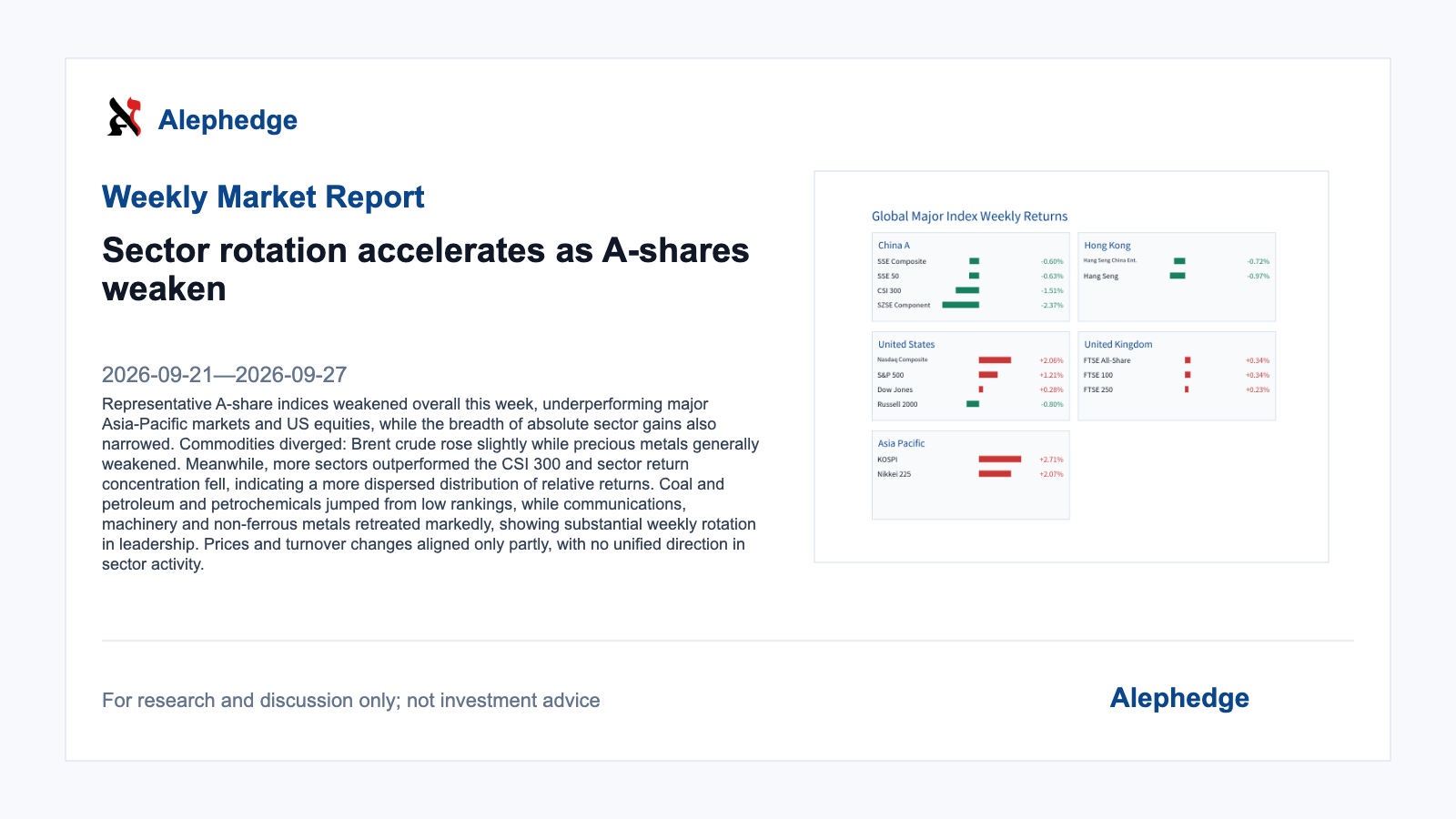
Most major Asia-Pacific and US indices were firm this week, while Hong Kong and A-shares weakened, with representative A-share indices falling relatively more. South Korea's KOSPI rose +2.71%, the Nikkei 225 +2.07% and the Nasdaq Composite +2.06%. US performance also diverged: the S&P 500 rose +1.21% and the Dow Jones Industrial Average +0.28%, while the Russell 2000 fell -0.80%. The Hang Seng fell -0.97%, the Shanghai Composite -0.60%, the CSI 300 -1.51% and the Shenzhen Component -2.37%. Major global equity markets diverged, with A-shares on the relatively weak side.
Commodity market signals
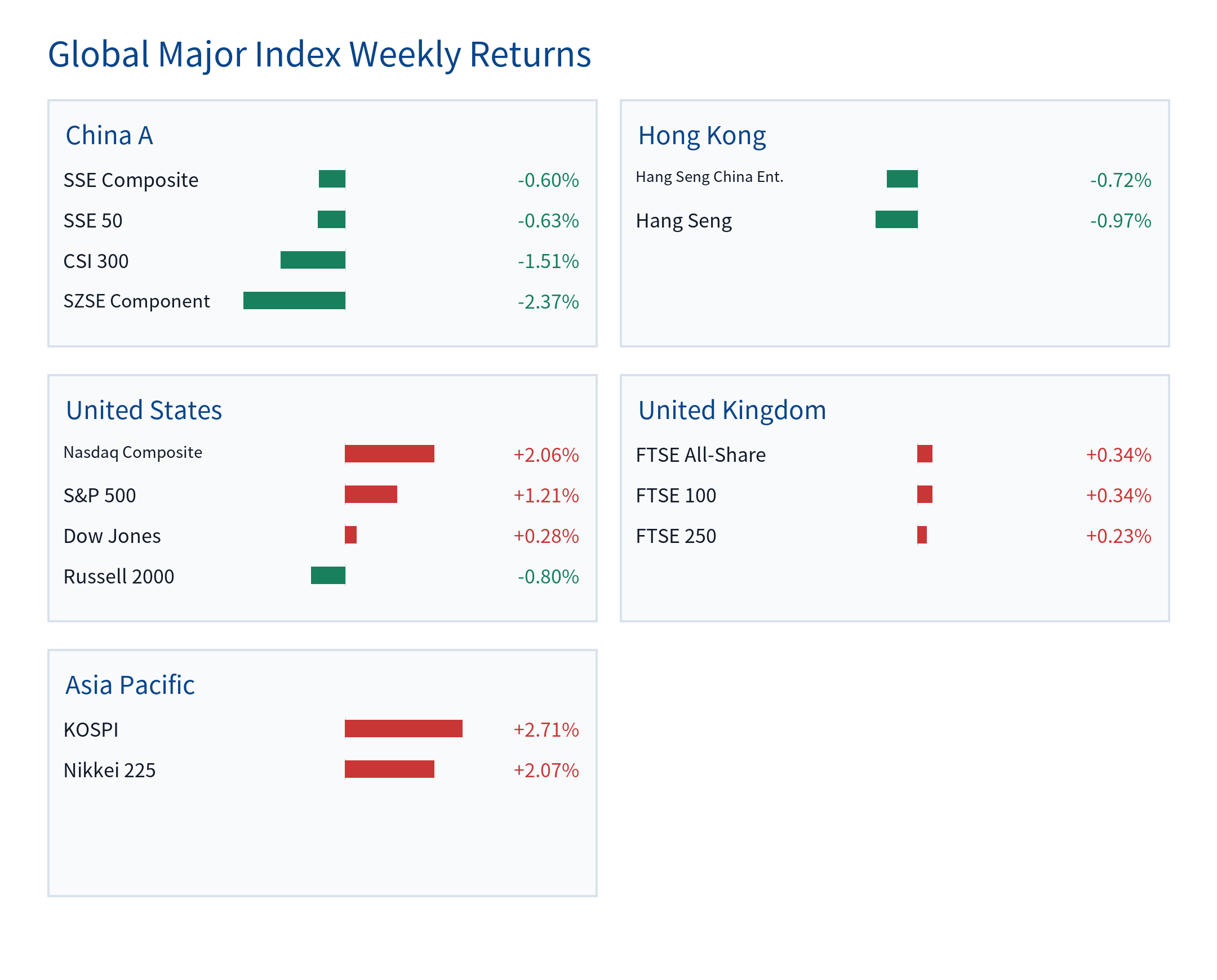
Commodities diverged this week. Brent crude edged higher while precious metals generally weakened. Brent rose +0.43%; London spot gold fell -2.13%, gold futures -2.34%, London spot silver -2.94% and silver futures -3.47%. Available data are insufficient to assess industrial metals overall, so the broad direction of commodities still requires cautious interpretation.
A-share market structure and sector rotation
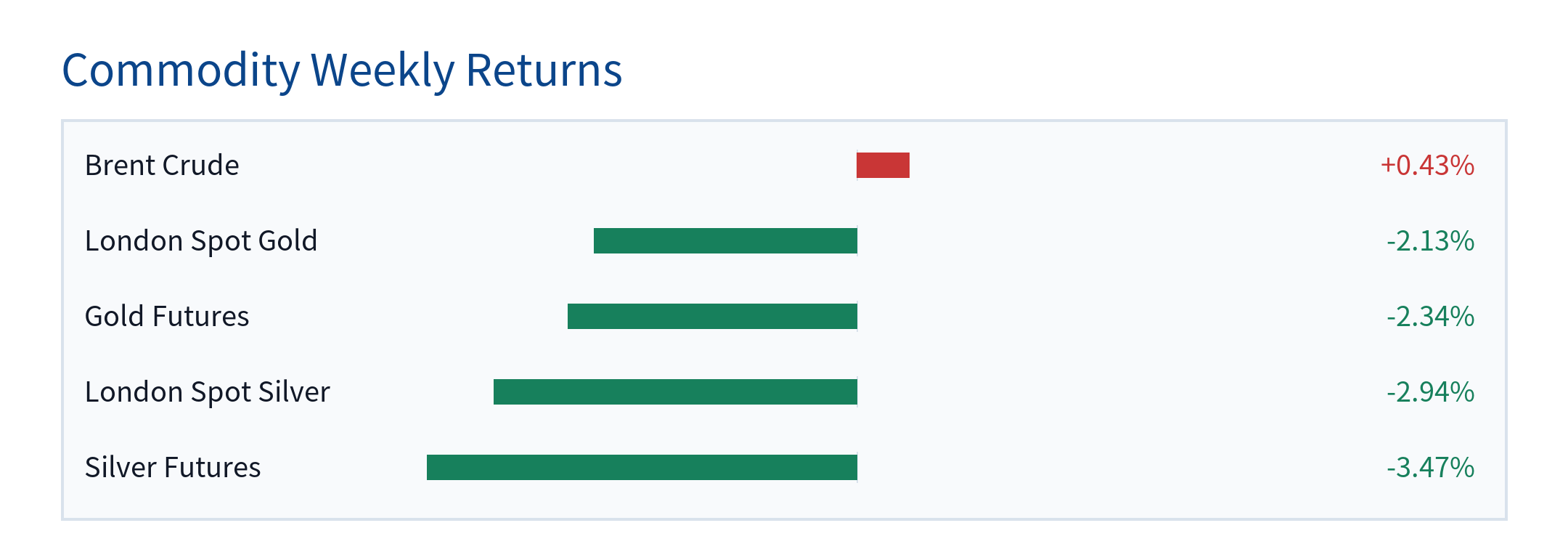
The breadth of absolute sector gains narrowed from last week, but more sectors outperformed the CSI 300. Relative sector returns were more dispersed and leadership rotated markedly. Only 9 of 31 sectors rose, representing 29.0%, down from 16 and 51.6%; however, 21 outperformed the CSI 300, representing 67.7%, up from 16 and 51.6%. Leading sectors' average return was +2.04%, against a median sector return of -0.77%. The gap was +2.81%, down from +4.31%, reflecting lower concentration. Coal rose from 29th last week to second, and petroleum and petrochemicals from 31st to fifth; communications fell from second to 30th and machinery from fifth to 28th. Rankings changed rapidly, which is insufficient to confirm a sustained trend.
A-share prices and trading activity
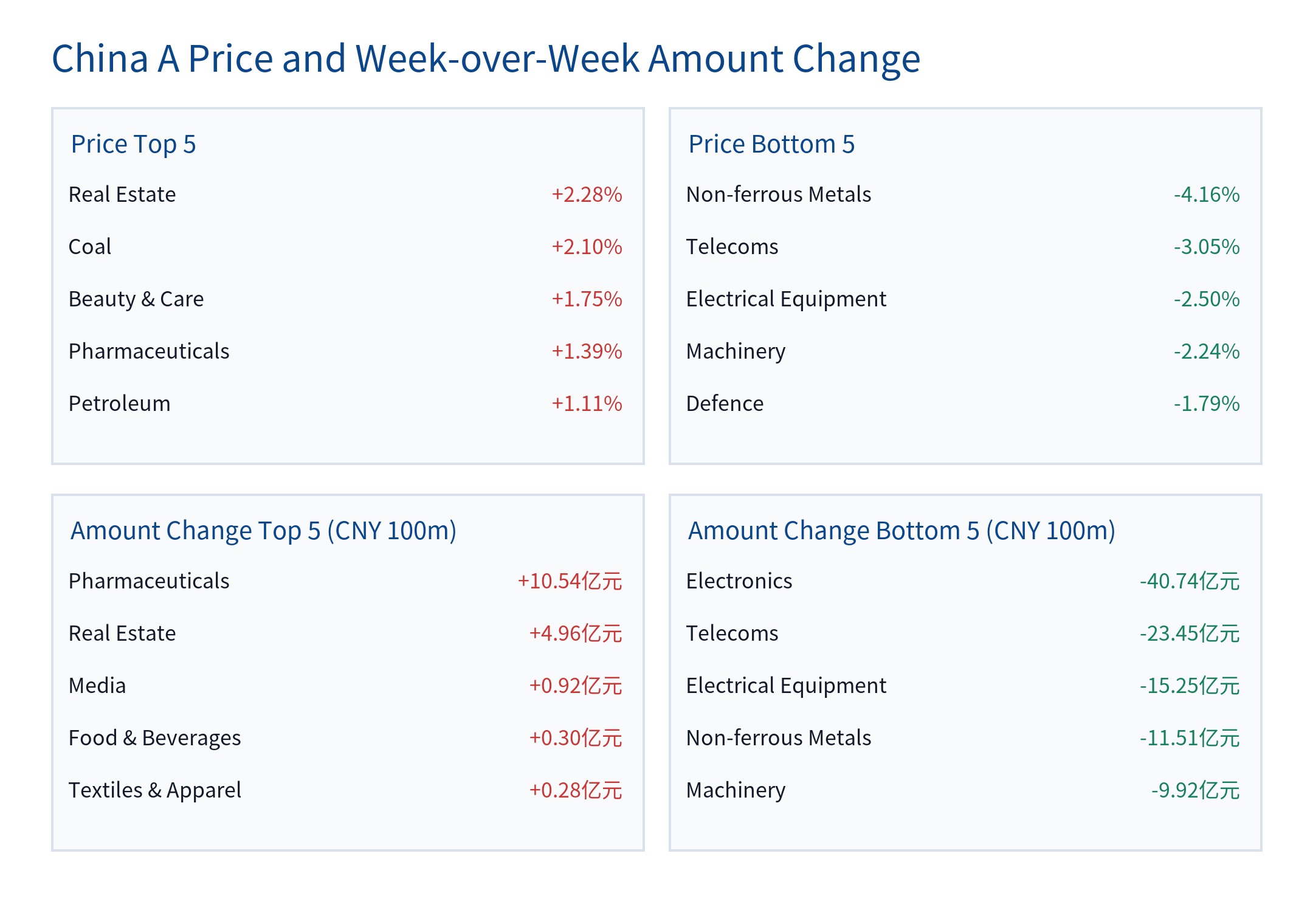
Sector prices and changes in turnover from last week aligned only partly, with no uniform relationship. Property rose +2.28% and turnover increased +4.96 hundred million yuan; pharmaceuticals and biotechnology rose +1.39% and turnover increased +10.54 hundred million yuan. Communications fell -3.05% and turnover fell -23.45 hundred million yuan; electrical equipment fell -2.50% and turnover fell -15.25 hundred million yuan. Non-ferrous metals fell -4.16% and turnover fell -11.51 hundred million yuan; machinery fell -2.24% and turnover fell -9.92 hundred million yuan. Meanwhile, coal and petroleum and petrochemicals rose on lower turnover, while media and food and beverages recorded higher turnover but weaker prices. Week-on-week turnover changes alone therefore cannot explain sector price strength.
What to watch
Watch changes in the numbers of sectors rising and outperforming the CSI 300 to track breadth. Continue to observe the rankings of sectors strengthening this week, including coal, petroleum and petrochemicals, and beauty and personal care, and changes in laggards including communications, machinery and non-ferrous metals. Also watch whether sector price performance and changes in turnover from last week continue to align only partly.
Analyst's view
2026, 21 September—25 September
A-share statistics run through the 24th because markets closed for the Mid-Autumn Festival on 25 September; Hong Kong and US statistics run through the 25th.
The week's most notable change was that the previous week's technology recovery did not continue simultaneously across all three markets. US equities kept rising on AI catalysts, Hong Kong rose then retreated, and A-shares gave back an early-week rebound. The same industry story met different pools of capital, positioning, company fundamentals and market conditions, ultimately producing different price changes.
Technology rebounds took completely different forms across markets, but the demands on entry prices, realised earnings, sector-specific macroeconomic fundamentals and buying support are rising. Last week's proposed tactical window for buying was partly validated in the US but faced resistance in Hong Kong and A-shares.
US equities: AI supports gains as high rates continue to limit breadth
US equities ended two consecutive down weeks. According to the Associated Press's Friday closing figures, the S&P 500 rose about 1.2% for the week, the Nasdaq Composite 2.06% and the Dow 0.3%. Technology leadership and small-cap underperformance remained clear.
Two forces shaped the week. Early on, the market response to Meta's new agent Muse boosted the AI trade, while falling oil prices improved risk appetite. Midweek, stronger-than-expected US PMI and hawkish Federal Reserve remarks pushed Treasury yields higher, and equities gave back some gains. Nasdaq research that week noted the 10-year Treasury yield rising to about 5.15%, while the Nasdaq 100 still gained about 3% over the week.
This shows that industry catalysts can temporarily offset rate pressure, but benefits are limited in scope. Large technology companies' growth expectations still attract funds, while smaller companies are more exposed to financing costs and economic uncertainty. US technology's rise and rebound were resilient, but indices nearing new highs do not prove that the whole market is strengthening. If gains remain concentrated in a few leaders, portfolio returns will depend more on stock selection, and crowded trades can amplify volatility in strong areas.
Within AI, distinguish growing application demand from realised hardware orders. Increased application usage offers a clue to computing demand, but sustained improvements in revenue, profit and cash flow ultimately support valuations. Without further positive news, valuations will lack continued support and consolidation will continue.
Hong Kong equities: gains reverse as absent southbound buying intensifies pressure on support
Hong Kong briefly exceeded 25000 early in the week, then fell for three consecutive sessions. The Hang Seng fell 0.97% over the week to 24510.09; the Hang Seng TECH Index fell 2.13% to 4311.78; the China Enterprises Index fell 0.72%. Technology again underperformed the broader market.
Friday's turnover change was particularly notable. With mainland markets closed for the Mid-Autumn Festival and southbound trading suspended, Hong Kong main-board turnover shrank to about 1022 hundred million Hong Kong dollars. The Hang Seng touched about 24275 intraday, then pared losses late on but still closed down. Platform technology, insurance and oil stocks generally came under pressure.
My interpretation is that absent southbound buying exposed Hong Kong's existing lack of support more clearly. However, the full week's weakness cannot all be attributed to Friday's suspension: indices had already fallen repeatedly, showing that the early rebound had not formed a stable trend. This clearly raises concern about foreign investors' confidence in Hong Kong without mainland buying support.
The conditions for a Hong Kong recovery still need testing, especially whether prices can truly stabilise after funds resume participation. A rebound becomes more credible only if turnover recovers and platform heavyweights improve alongside the Hang Seng TECH Index. If indices keep weakening after participation resumes, earnings expectations and valuation pressure need reassessing.
A-shares: the rebound fails to last as trading cools later in the week
Major A-share indices all closed lower over four trading days. The Shanghai Composite fell 0.60% to 3888.37; the Shenzhen Component fell 2.37%, ChiNext 2.48% and the STAR 50 1.86%. Average daily Shanghai and Shenzhen turnover was about 1.90 trillion yuan.
Separate the week's turnover from the final session: higher weekly average turnover shows reasonable participation early in the week, while lower turnover and falling prices later indicate weaker buying support.
Structurally, AI hardware including PCB and CPO corrected on Thursday, gold and industrial metals came under pressure, and banks and wind-power equipment were relatively strong. For the full week, property and coal led, while non-ferrous metals lagged.
My view: the optimism created by last week's technology advance on increased turnover did not receive sustained buying support this week. Pre-holiday caution explains some cooling in trading, but larger falls in growth indices and simultaneous technology corrections also show limited willingness to keep chasing prices higher.
Technology remains worth researching, but short-term assessment should put more weight on price and volume together: can leaders stop falling after the correction, can the rebound extend to more companies, and can turnover keep increasing on advances? Without improvement in these conditions, frequent positive industry news alone is insufficient to increase confidence in the rally's durability.
Gold weakened during the week. This also revises the previous assessment of gold's resilience: the long-term allocation case remains open to research, but short-term moves still respond to the dollar and interest rates. For now, wait for prices and macroeconomic conditions to align again before assessing the strength of an upward recovery.
Three points most need updating this week: stronger US technology did not automatically lift Hong Kong and A-shares; positive industry news still needs confirmation from turnover and prices; and whether a correction on falling turnover is nearing its end depends on subsequent buying support.
Risk warning
This report describes the weekly market data supplied and does not constitute investment advice. Single-week prices, sector rankings and turnover changes may be highly volatile and are insufficient to confirm a continuing trend.