

Market Weekly · 2026-09-14—2026-09-20
2026-09-14—2026-09-20|A-share sector breadth improves
Executive summary
Slightly more than half of A-share sectors rose and outperformed the CSI 300 this week. Return concentration eased from last week, but leadership mainly reflected reversals in weekly rankings, with some previously high-ranking sectors becoming laggards. Markets diverged: representative UK indices all rose, A-share and Asia-Pacific markets were mixed, Hong Kong fell slightly, and only the Nasdaq Composite rose in the US. Precious metals strengthened, especially silver, while Brent crude fell slightly. Electronics rose +6.06% on higher turnover than last week, aligning price strength with increased activity. Turnover fell in most other leading sectors; turnover changes do not represent net inflows.
Global equity market performance
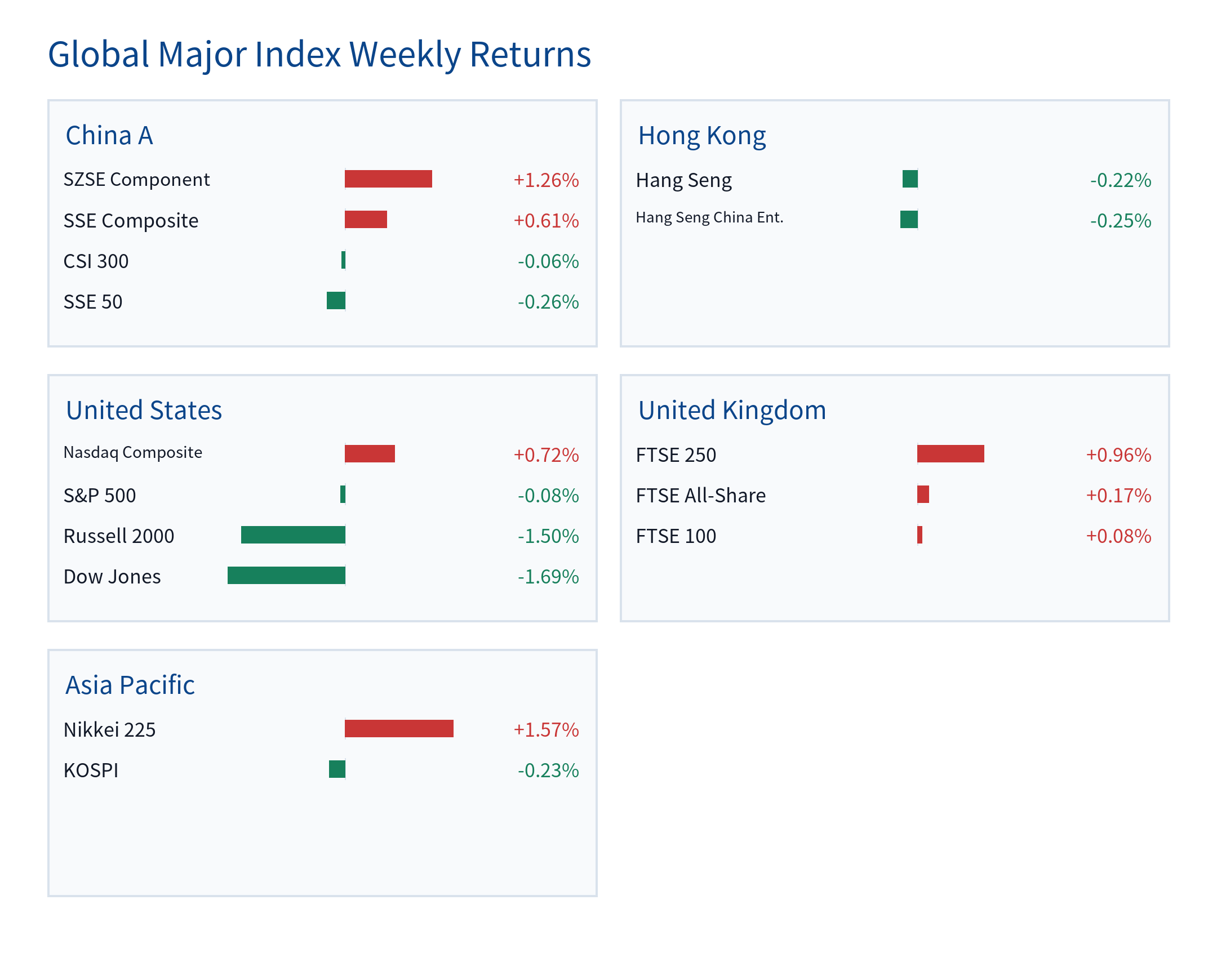
Major global equity markets diverged this week. Representative UK indices all rose, while A-shares and Asia-Pacific markets were mixed. The FTSE 250 rose +0.96%, the Shenzhen Component +1.26% and the Nikkei 225 +1.57%. Both representative Hong Kong indices fell slightly; in the US, only the Nasdaq Composite rose, gaining +0.72%, while the other representative indices weakened. Without aggregate returns for each market group, these figures should not be used to rank overall strength across markets.
Diverging commodities
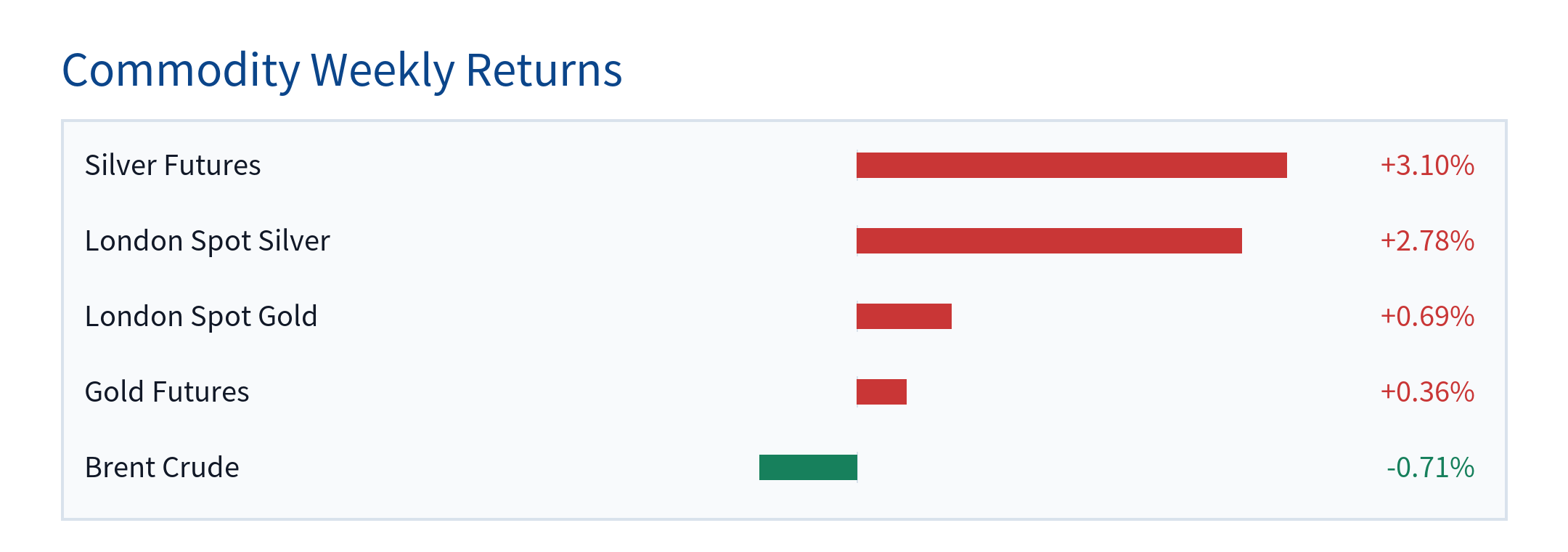
Precious metals strengthened while energy weakened this week. Silver futures rose +3.10%, London spot silver +2.78%, London spot gold +0.69% and gold futures +0.36%; Brent crude fell -0.71%. Industrial metals data were not supplied, preventing a complete comparison of major commodity groups.
A-share breadth, concentration and sector rotation
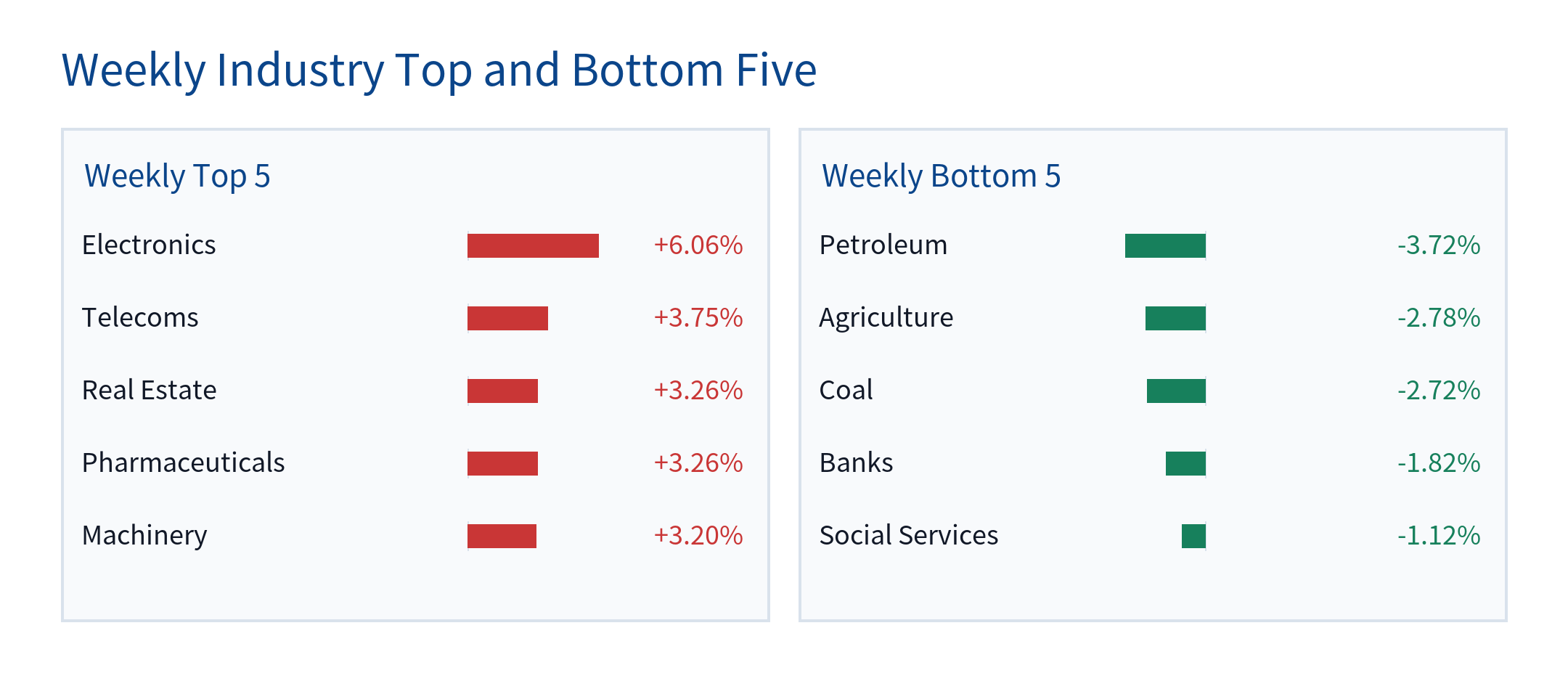
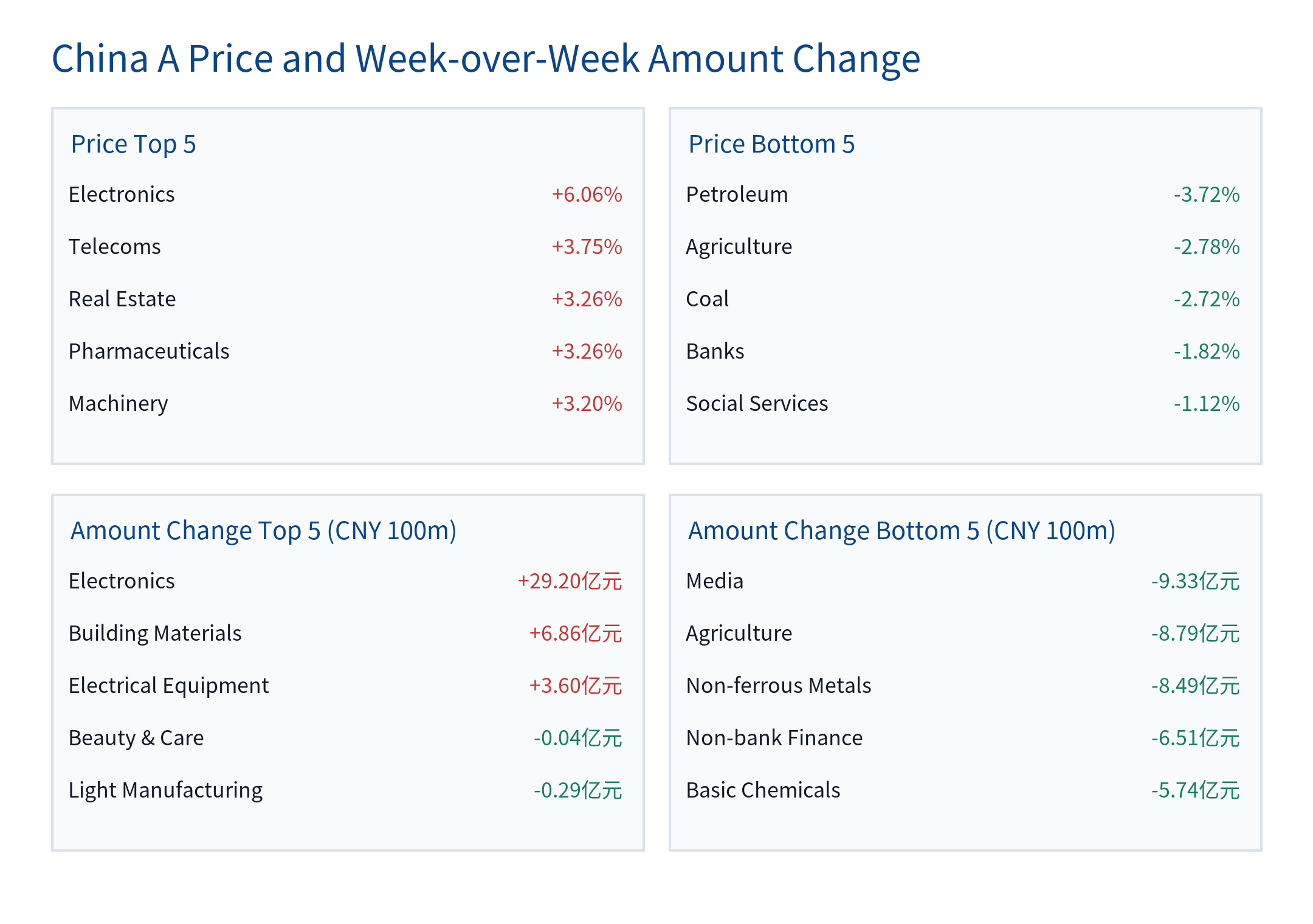
A-share sector breadth improved this week, but leadership shifted through reversals in weekly rankings. Of 31 sectors, 16 rose and 16 outperformed the CSI 300, both representing 51.6%, up 29.0 percentage points and 19.4 percentage points respectively from last week. The gap between leading sectors' average return and the sector median narrowed to +4.31%, indicating that returns remained concentrated, but less so. Property climbed from 24th to third, pharmaceuticals and biotechnology from 26th to fourth, and machinery from 12th to fifth. Petroleum and petrochemicals, agriculture, forestry, livestock and fisheries, and coal became laggards. None of this week's top five sectors was continuing earlier strength.
A-share prices and trading activity
Sector price performance and changes in turnover from last week were only partly aligned. Electronics rose +6.06%, with turnover increasing +29.20 hundred million yuan, matching price strength with higher trading activity. Communications, property, pharmaceuticals and biotechnology, and machinery were among the leading gainers, but all had lower turnover than last week. Agriculture, forestry, livestock and fisheries fell -2.78%, with turnover declining -8.79 hundred million yuan. Turnover changes reflect activity, not net inflows.
What to watch
Watch whether the proportions of sectors rising and outperforming the CSI 300 stay above half, and whether the return gap between leading sectors and the sector median keeps changing. Also watch whether strong sectors continue to be driven mainly by weekly ranking reversals, whether electronics' prices and turnover changes remain aligned, and how the rankings of this week's laggards, including petroleum and petrochemicals, agriculture, forestry, livestock and fisheries, and coal, change.
Analyst's view
The Federal Reserve raised rates by 25 basis points this week, lifting the federal funds target range to 3.75%—4.00%. Its statement also said the economy continued to expand steadily and inflation remained elevated. Markets therefore face rising financing costs while still receiving support from the economy and corporate demand.
The Bank of Japan simultaneously raised its policy rate to 1.25%, reinforcing the backdrop of monetary policy normalisation in major economies.
US equities: technology remains resilient, but participation is narrow
At Friday's close, the S&P 500 was down about 0.1% for the week, the Dow down 1.7%, the Nasdaq Composite up 0.7% and the Russell 2000 down 1.5%. Technology outperformed traditional blue chips and small caps, reflecting continued sharp internal divergence.
The positive aspect is technology's resilience under rate pressure, suggesting support from some growth expectations. The reason for caution is that small caps and most stocks have not improved together; index performance can conceal pressure on ordinary individual shares.
My view: opportunities in US equities are currently better sought through the ability to deliver earnings. Semiconductors, memory and equipment remain worth tracking, but distinguish order growth and improving supply and demand from simple valuation expansion. Innovative drugs and the crypto supply chain have separate catalysts and cannot all be folded into the same rationale for rising technology stocks.
The most valuable subsequent signal would be technology retaining strength while small caps and equal-weight indices gradually stabilise. Broader gains would strengthen the rally's foundations; further concentration could amplify volatility in strong stocks through crowded trading.
Hong Kong equities: technology recovers first, but platform heavyweights diverge
On Friday, the Hang Seng closed around 24750, up 0.6% that day; the Hang Seng TECH Index rose 2.2%. For the week, the Hang Seng fell about 0.2%, while the Hang Seng TECH Index gained nearly 2%. AI-related stocks were active, but platforms differed, with Alibaba and Tencent diverging markedly on Friday.
These results show a recovery in parts of Hong Kong's market, but confidence at index level has not fully returned. Continued technology gains still need joint support from turnover and earnings expectations.
For Hong Kong equities, examine both growth potential and operating quality. AI hardware depends on orders and deliveries; internet platforms on monetisation, core-business profits and shareholder returns; AI drug development on tangible results such as clinical data and licensing partnerships. Catalyst cycles differ across these areas.
A-shares: technology leads the advance; persistence matters after Friday's higher turnover
Major A-share indices rose this week: the Shanghai Composite gained 0.61%, the Shenzhen Component 1.26%, ChiNext 1.52% and the STAR 50 6.39%. Advanced packaging, memory chips and lithography equipment were strong, with technology's style advantage prominent.
However, turnover needs two perspectives: Friday's return above 2 trillion yuan shows renewed willingness among short-term observers to participate, while lower weekly average daily turnover than the previous week means sustained new inflows remain insufficiently confirmed.
My view: technology's position as the central theme has strengthened, but a single day's higher turnover is insufficient to confirm a new broad rally. Next, focus on whether buying support appears when sectors diverge. If turnover does not shrink quickly, the tactical recovery continues.
Risk warning
This report is compiled from the weekly market data supplied, for information only. It constitutes neither investment advice nor a promise of returns. Market performance may change; increases or decreases in sector turnover from last week do not represent net fund inflows.