

Market Weekly · 2026-09-07—2026-09-13
2026-09-07—2026-09-13|A-share breadth contracts as returns concentrate in reversal-led sectors
Executive summary
A-shares weakened and sector breadth contracted this week. Only 7 of 31 sectors rose, concentrating returns in a few leaders. Communications, building materials, diversified companies and electronics led through reversals, while non-bank financials, IT and beauty and personal care moved from relatively high rankings last week to near the bottom. Sector prices partly corresponded to turnover increases or decreases from last week, but did not move fully in step. Turnover changes reflect trading activity only, not net fund inflows. Global equities were weak overall; Asia-Pacific markets diverged, with Hong Kong's decline prominent. Commodities also diverged: Brent crude rose +8.65%, while gold and silver futures and spot prices retreated.
Comparing global equity markets
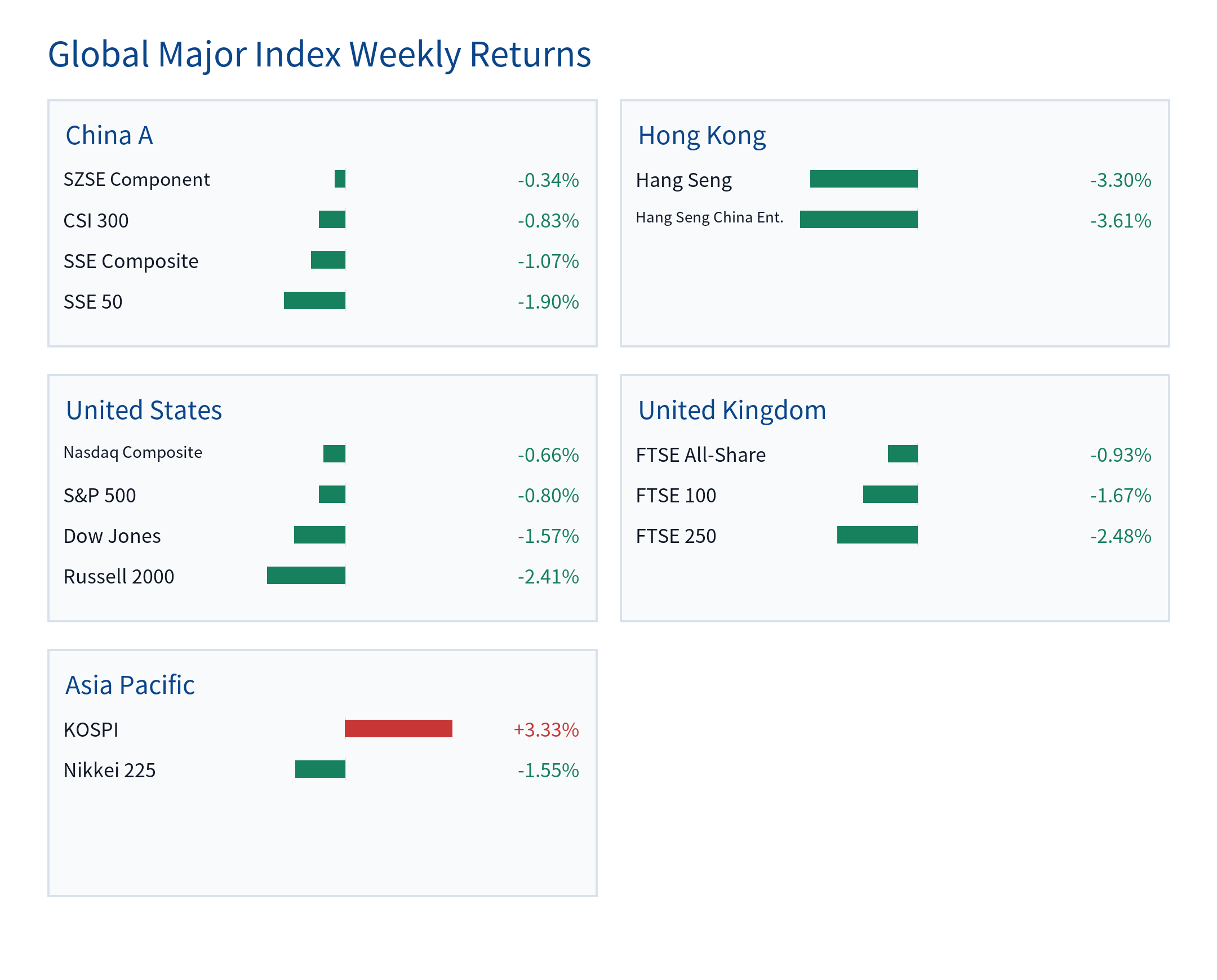
Global equities were weak overall this week, with divergence within Asia-Pacific. South Korea's KOSPI rose +3.33%, while the Nikkei 225 fell -1.55%. Hong Kong was relatively weak: the Hang Seng fell -3.30% and the Hang Seng China Enterprises Index -3.61%. Among representative A-share indices, the Shenzhen Component fell -0.34%, the CSI 300 -0.83% and the Shanghai Composite -1.07%. Most major US indices also closed lower. The available sample shows widespread pressure, but relative strength still differed across markets.
Diverging commodity performance
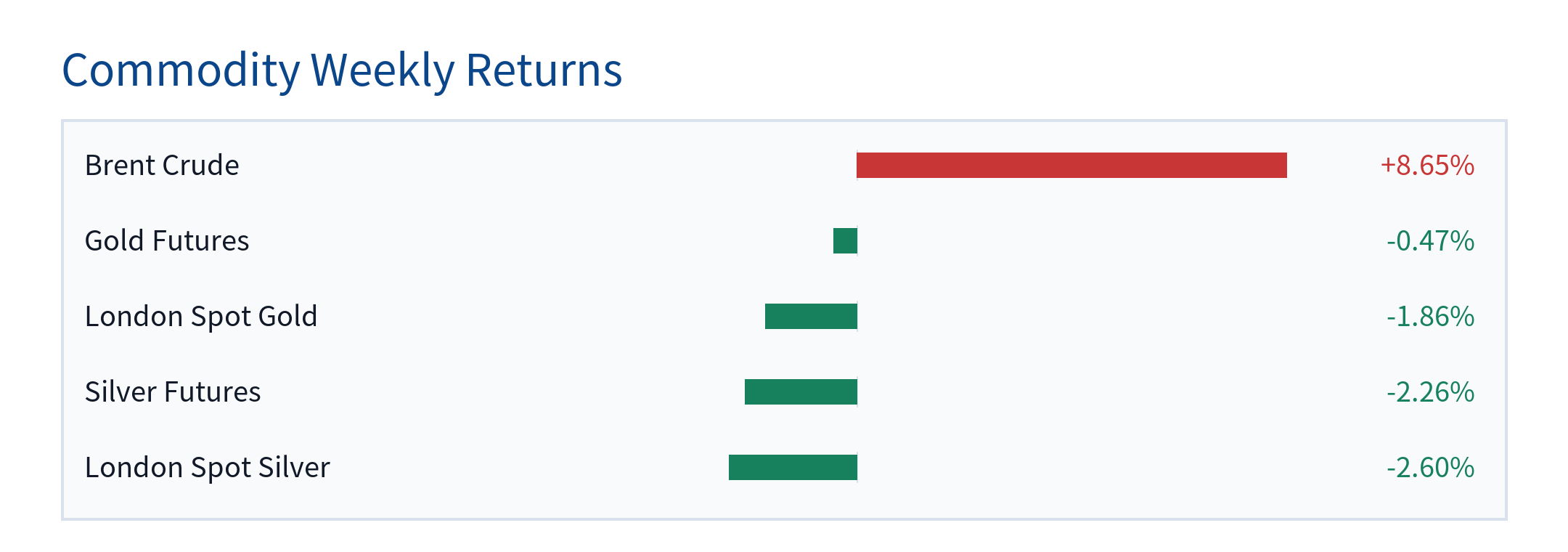
Commodities diverged this week, with stronger energy and generally lower precious metals. Brent crude rose +8.65%, gold futures fell -0.47%, London spot gold -1.86%, silver futures -2.26% and London spot silver -2.60%. The supplied sample contains no industrial metals data, so it cannot establish broader commodity performance.
Contracting A-share sector breadth and concentrated returns
A-share sectors were weak this week and breadth narrowed. Only 7 of 31 sectors rose, representing 22.6%, down from 14 and 45.2% last week. A total of 10 sectors outperformed the CSI 300, representing 32.3%, also below last week's 18 and 58.1%. Meanwhile, leading sectors' average return was +4.00%, against a sector median of -1.81%, a gap of +5.81%, above last week's +5.28%. Positive returns were therefore mainly concentrated in a few leading sectors.
Sector rotation: reversal-led gains coexist with newly weak sectors
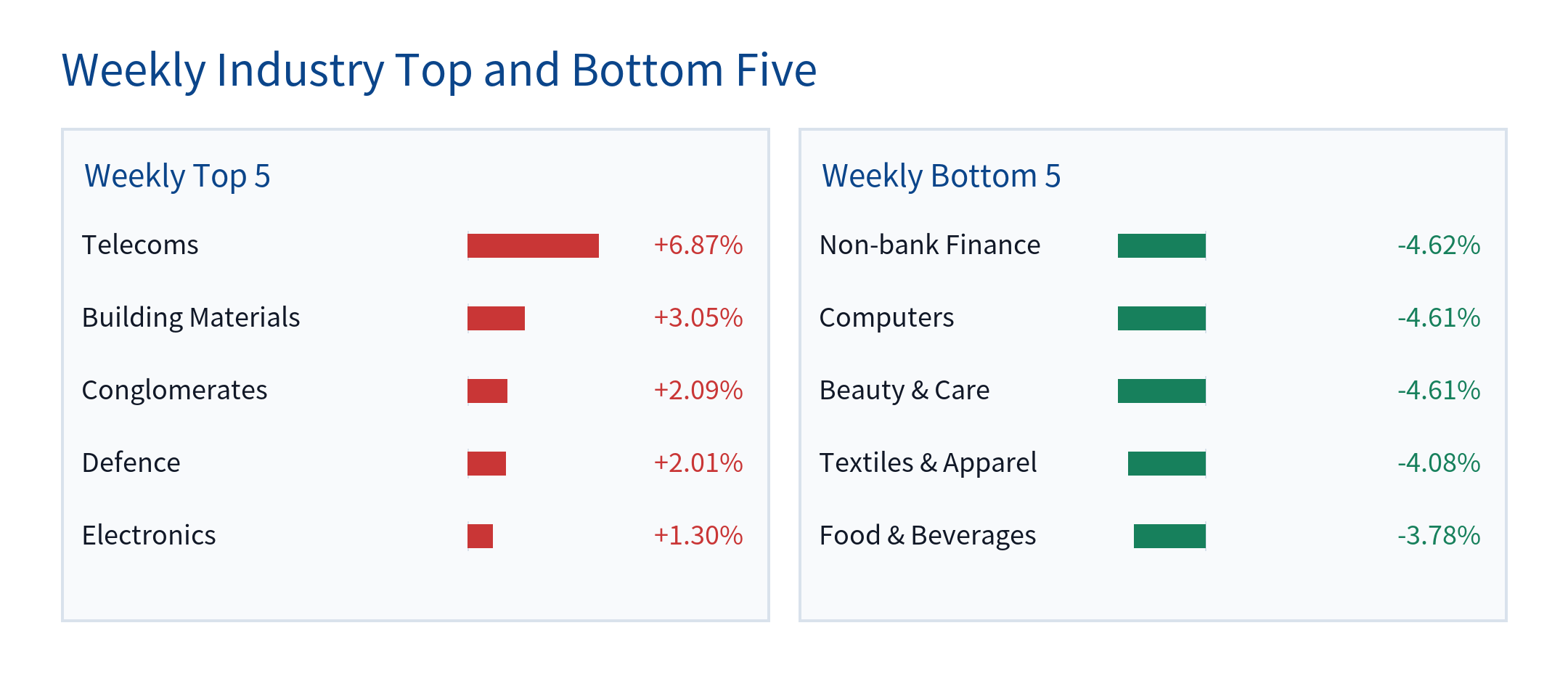
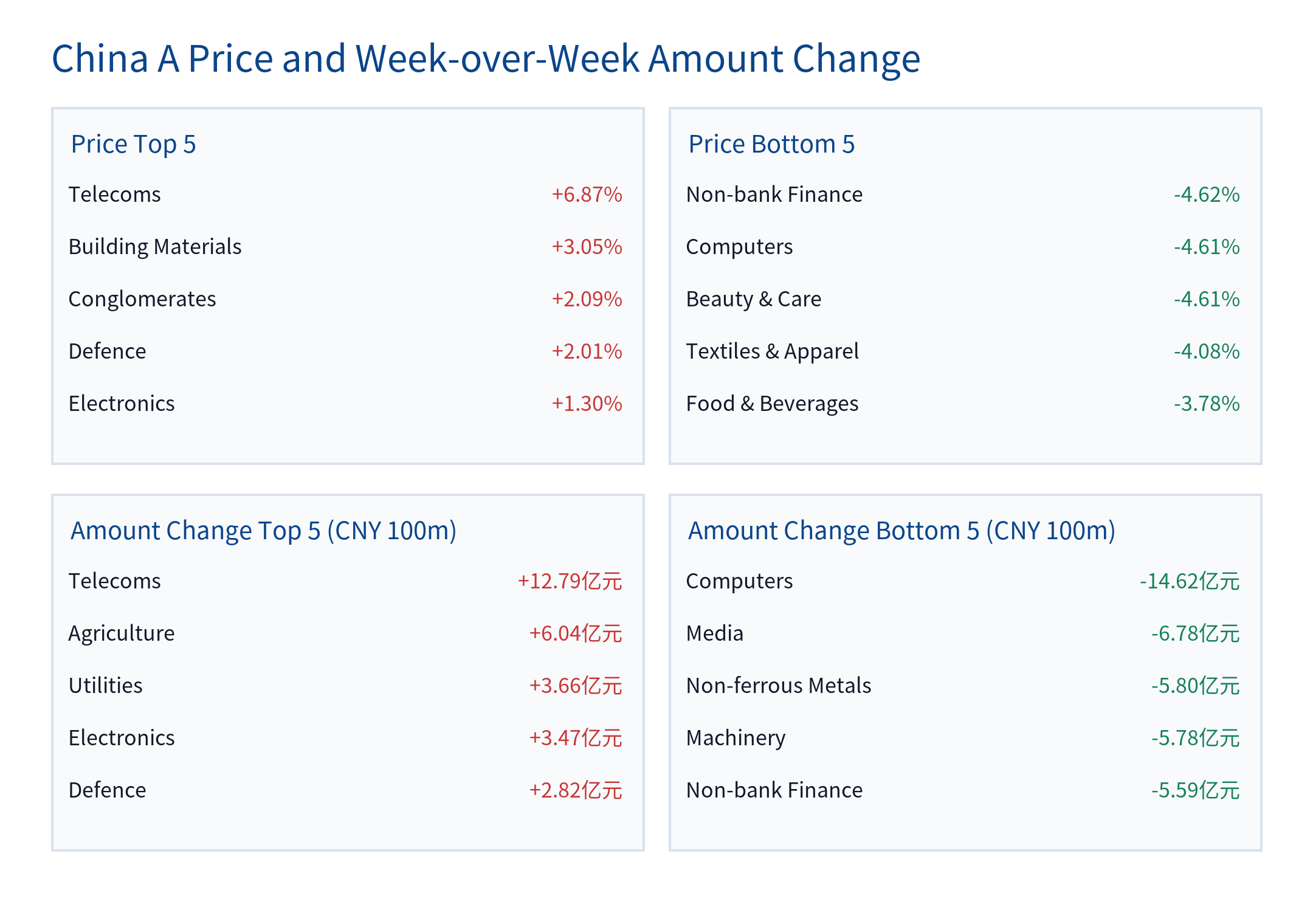
Sector strength rotated markedly this week. Communications rose +6.87%, climbing from 28th last week to first; building materials rose +3.05%, moving from 29th to second; electronics rose +1.30%, from 31st to fifth. Defence also remained near the top. By contrast, non-bank financials, IT and beauty and personal care fell -4.62%, -4.61% and -4.61% respectively, dropping from relatively high positions to near the bottom. Their weakness was thus more a new development this week than continued underperformance.
A-share prices and changes in trading activity
Price strength and turnover changes partly corresponded overall. Communications rose +6.87%, with turnover increasing +12.79 hundred million yuan. Electronics rose +1.30% and defence +2.01%, both on higher turnover. IT fell -4.61% and non-bank financials -4.62%, both on lower turnover. Agriculture, forestry, livestock and fisheries had a turnover increase of +6.04 hundred million yuan but fell -1.59%. Media, non-ferrous metals and machinery had lower turnover but were not among the bottom five by price return, showing that the two changes were not fully aligned.
What to watch
Watch whether the proportions of sectors rising and outperforming the CSI 300 continue to change, and whether the gap between leading sectors and the sector median widens or narrows. Track rankings in communications, building materials, diversified companies and electronics, and relative ranking changes in non-bank financials, IT and beauty and personal care. Continue to observe the consistency between price performance and turnover changes from last week.
Analyst's view
Last week's central change was a shift from hesitation over news towards clearer risk reduction. A-shares fell on increased turnover after trading cooled, Hong Kong corrected repeatedly, and US equities rebounded on Friday but still closed down for the week. Technology did not weaken uniformly, however: optical communications and large-model companies diverged markedly. My assessment is that investors still seek growth opportunities, but their demands on valuations, competition and entry prices are rising.
For the week, the Shanghai Composite fell 1.07% to 3888.11, the Shenzhen Component fell 0.34%, but ChiNext rose 1.08%. This combination means the earlier assessment that technology and growth broadly underperformed the main board cannot simply be carried forward. Some growth areas recovered, but this had not broadened into sustained gains across the market. Optical communications and optical modules briefly recovered intraday following some demonstrations at the optoelectronics exhibition, but mostly consolidated over the week.
Volume is an important clue to the week. Shanghai turnover fell to about 7796 hundred million yuan on Thursday, then rose to 9581 hundred million yuan on Friday, but more than 4800 stocks fell. All three major indices were down more than 2% intraday before paring losses in the afternoon. Higher volume after a contraction initially accompanied selling pressure, rather than widespread gains. The afternoon recovery showed buying support at lower prices, but alone was insufficient to conclude the correction had ended.
This also revises our earlier interpretation of lower turnover. It can reflect reluctance to sell or buyers waiting on the sidelines; subsequent prices and the number of advancing stocks must be considered. The latter half of last week pointed more towards insufficient buying: indices lacked sustained upward impetus, and breadth deteriorated when additional trading appeared. More valuable than whether an index turns positive on a particular day is whether gains spread and rebounds keep receiving turnover support.
Hong Kong's pressure was more concentrated. The Hang Seng fell for five consecutive days, closing near 24805 on Friday, an almost two-month low. The Hang Seng TECH Index fell 5.45% over the week, clearly underperforming. Meanwhile, southbound funds still bought about 44 hundred million Hong Kong dollars net on Friday, marking five consecutive days of net inflows. Buying flows and an index stopping its decline are separate matters. Southbound support existed but was insufficient that week to reverse the overall price trend.
Hong Kong technology faced two sources of pressure. Externally, stronger expectations of US rate rises pressured valuations of rate-sensitive growth assets. Internally, DeepSeek's price cuts raised competition concerns. Lower model prices help expand applications but may squeeze model suppliers' revenues and profit margins. AI technological progress therefore does not directly mean all AI companies benefit.
Against our earlier focus on technology momentum, the week's most instructive contrast was optical communications versus large-model stocks: Hong Kong-listed CIG rose over 24%, YOFC over 15% and Zhongji Innolight over 14%, while Zhipu and MiniMax fell over 27% and 25% respectively. These performances support continued distinctions between AI supply-chain segments.
US equities were also under pressure for the full week: the S&P 500 fell 0.8%, the Nasdaq Composite about 0.7%, the Dow 1.6% and the Russell 2000 2.4%. Larger small-cap declines show the correction was not confined to highly valued technology. The S&P rose 0.9% on Friday, ending four consecutive down sessions but not recovering all weekly losses.
External risks for the US still transmitted mainly through oil prices. On Thursday, oil rose to its highest since May, adding inflation concerns and bond-market pressure, and equities fell. The transmission is clear: higher energy prices raise costs and inflation pressure, reinforce expectations of rates staying high or rising further, and ultimately constrain equity valuations. Even unchanged industry prospects cannot insulate a company's share price from this common variable. Three points in our earlier review framework need updating. First, lower turnover cannot automatically mean a correction is nearing its end; subsequent advancing-stock counts and price-volume alignment must confirm it. Second, AI still requires analysis by segment: relative optical-communications strength can coexist with competitive pressure on model companies. Finally, a one-day rebound reflects that moment's balance of buyers and sellers; a sustained trend needs confirmation over more sessions.
Risk warning
This report describes only the weekly market data supplied and does not constitute investment advice. Increases or decreases in sector turnover from last week reflect only trading activity, not net fund inflows. Market performance and sector rankings may change in subsequent periods.