

Market Weekly · 2026-08-31—2026-09-06
2026-08-31—2026-09-06|A-shares weaken as sector returns concentrate in a few reversals
Executive summary
Hong Kong equities were relatively stronger overall this week, while most major US indices edged higher. A-shares and the listed Asia-Pacific indices were weak, with marked divergence within A-shares. The proportion of rising A-share sectors contracted to 45.2% and leading returns became more concentrated. Sectors with pronounced ranking reversals, including media, banking and defence, led, while electronics and non-ferrous metals weakened markedly. Energy strengthened and precious metals retreated. In most A-share sectors, price strength broadly aligned with changes in trading activity, but turnover changes reflect activity only, not net fund inflows.
Global market comparison
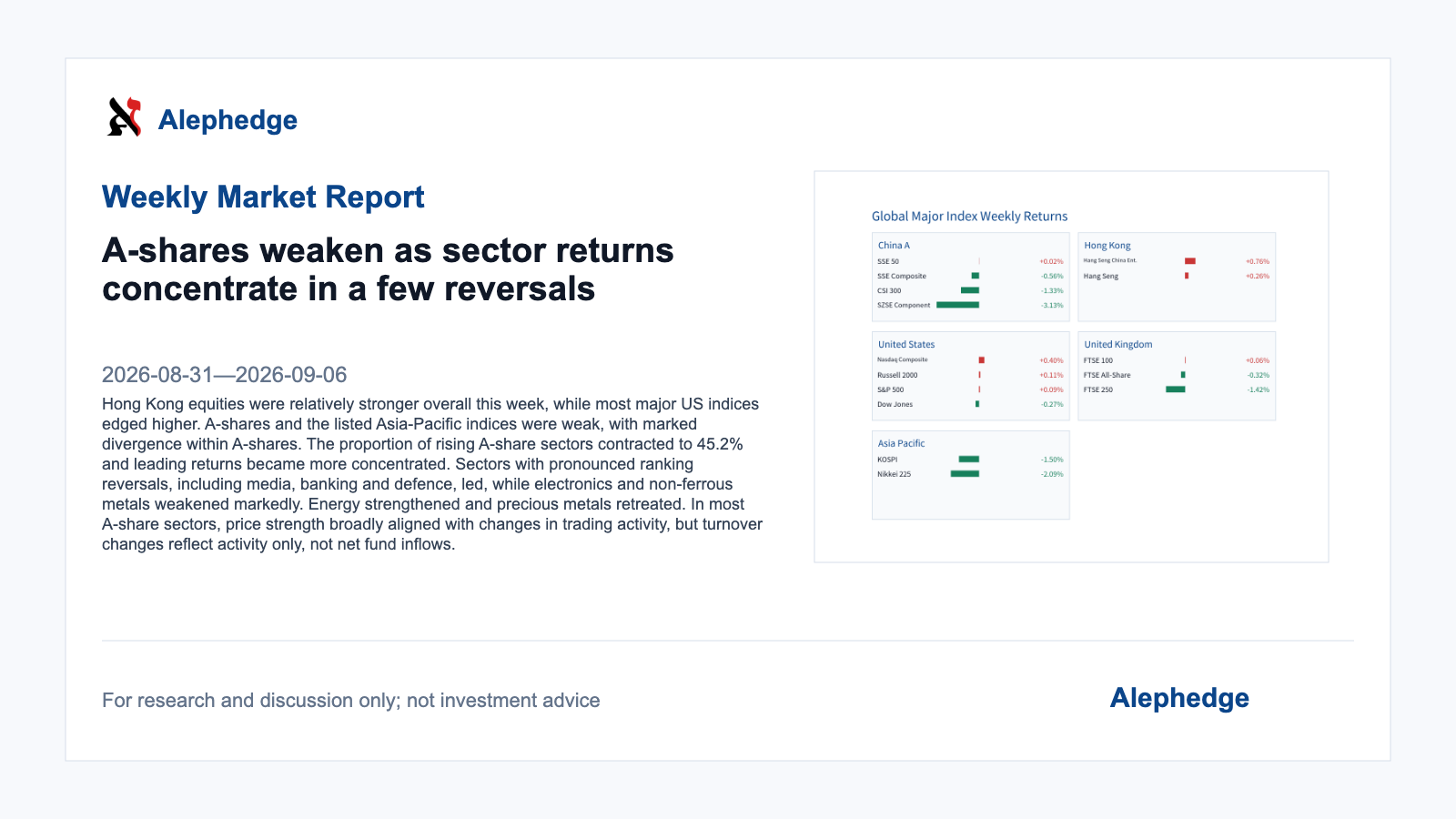
Markets diverged this week: Hong Kong was relatively strong and most major US indices edged higher, while A-shares, the UK and the listed Asia-Pacific markets were weak overall. The Hang Seng China Enterprises Index rose +0.76% and the Hang Seng +0.26%; the Nasdaq Composite rose +0.40%, the Russell 2000 +0.11% and the S&P 500 +0.09%, while the Dow Jones Industrial Average fell -0.27%. In the UK, the FTSE 100 rose +0.06%, the FTSE All-Share fell -0.32% and the FTSE 250 -1.42%. In A-shares, the SSE 50 rose +0.02%, the Shanghai Composite fell -0.56%, the CSI 300 -1.33% and the Shenzhen Component -3.13%; South Korea's KOSPI and the Nikkei 225 fell -1.50% and -2.09% respectively. Overall, Hong Kong led relatively, while A-shares internally, the UK and the listed Asia-Pacific markets were weak.
Commodity signals
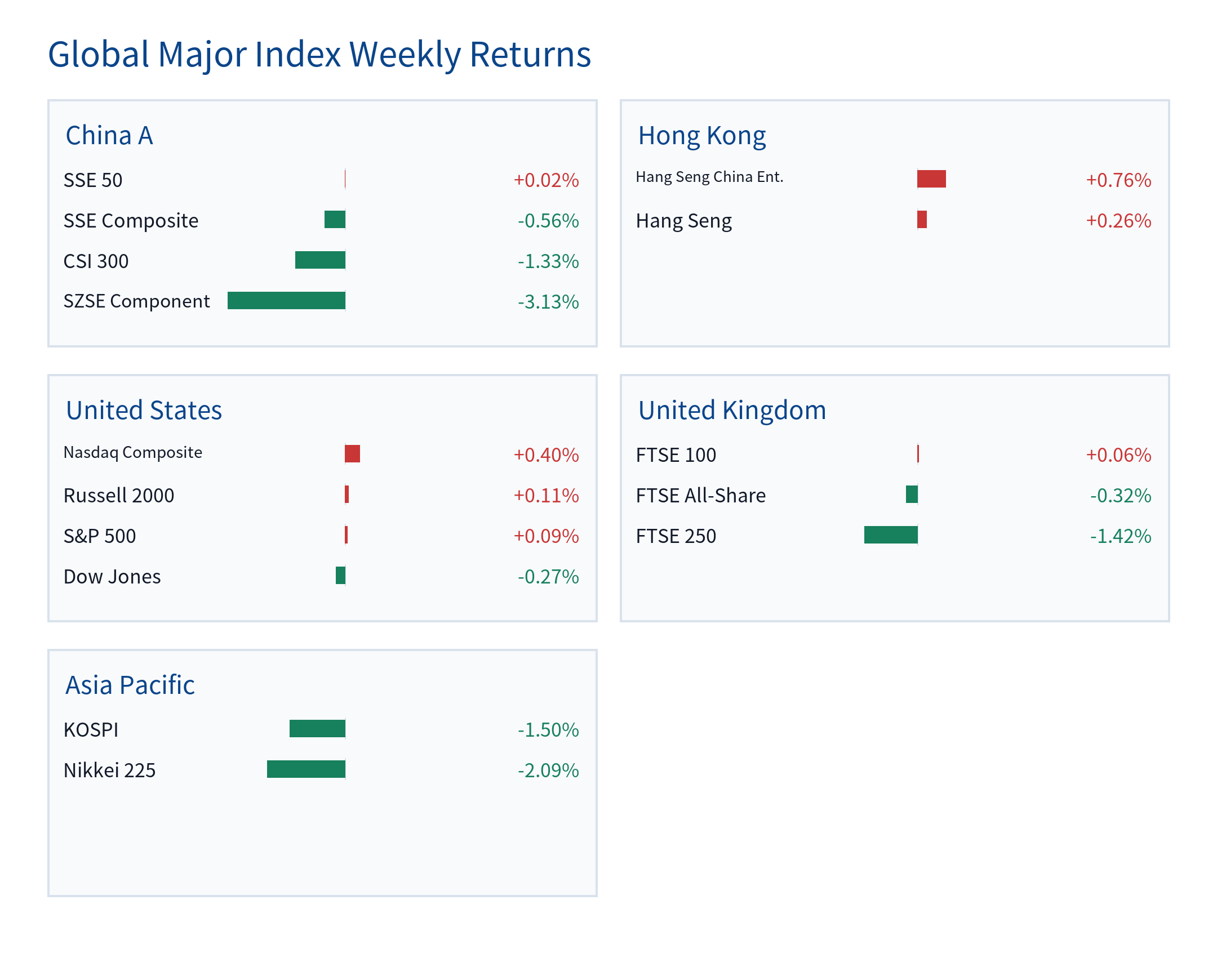
The supplied commodity data show sharply stronger energy and slightly lower precious metals. Brent crude stood out with a +7.80% gain; London spot gold fell -0.52%, gold futures -1.08%, London spot silver -0.19% and silver futures -1.42%. No specific industrial metals performance was supplied, so their relative strength against energy and precious metals cannot be assessed.
A-share sector breadth, concentration and rotation
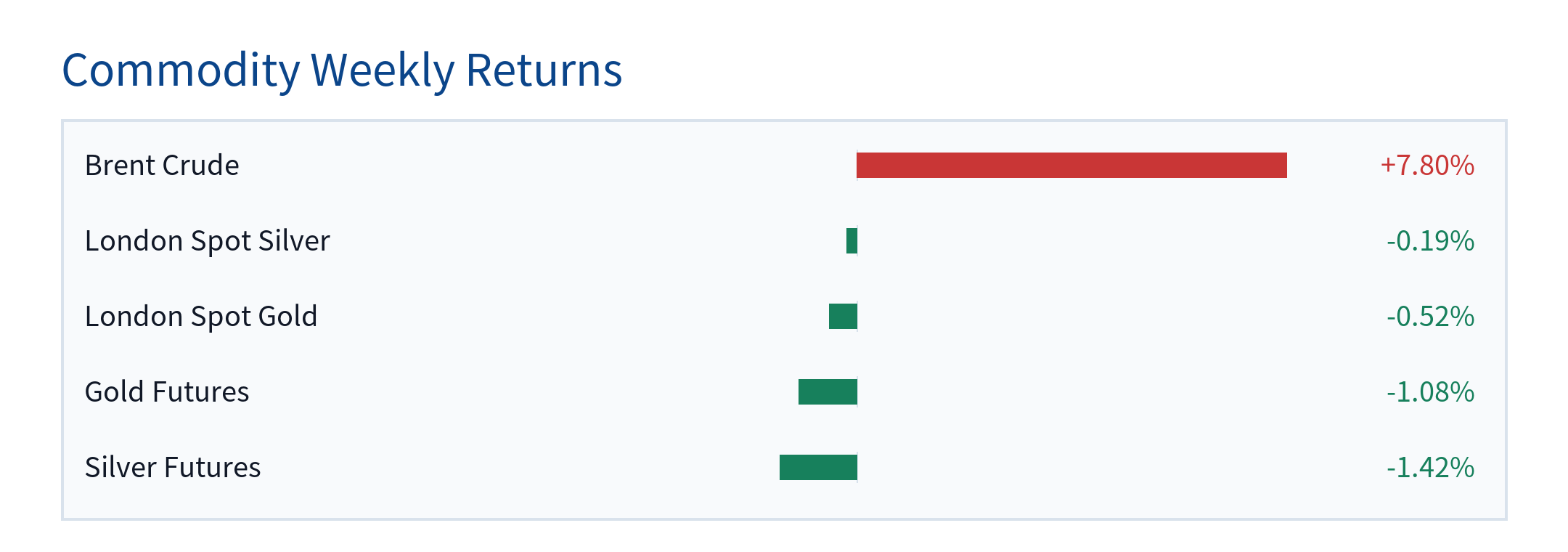
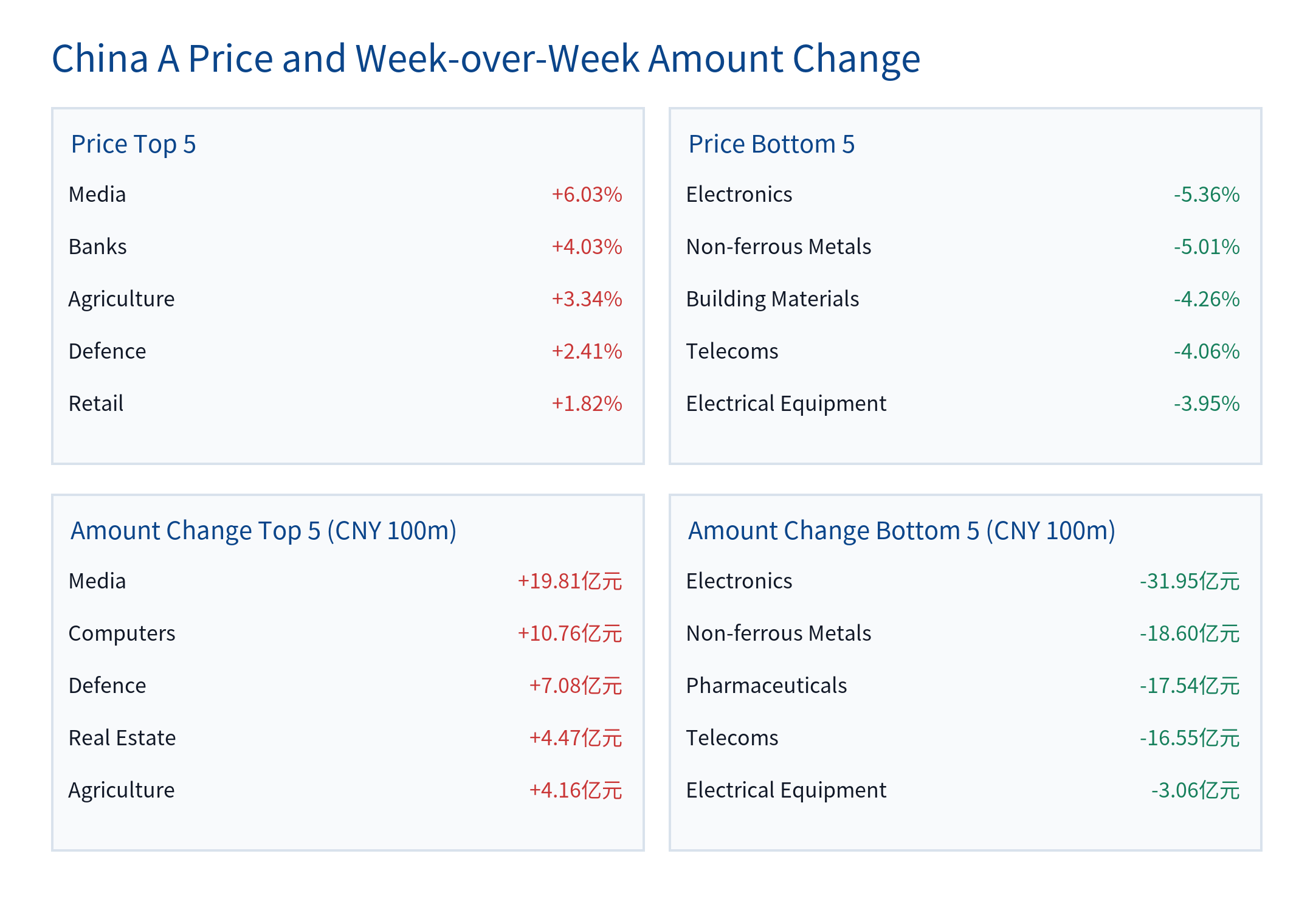
A-share sector performance was narrow this week, with leading returns concentrated in a few sectors and leadership mainly driven by weekly reversals. Of 31 sectors, 14 rose, representing 45.2%, and 18 outperformed the CSI 300, representing 58.1%, down 41.9 percentage points and 29.0 percentage points respectively. Leading sectors' average return was +4.47%, against a median sector return of -0.81%. The gap widened to +5.28%, from +3.46%, indicating greater concentration. Media rose +6.03%, climbing from 25th to first; banking rose +4.03%, from 27th to second; defence rose +2.41%, from 16th to fourth. Agriculture, forestry, livestock and fisheries rose +3.34%, slipping from first to third but remaining among the leaders. By contrast, electronics fell -5.36%, non-ferrous metals -5.01% and building materials -4.26%, newly weakening markedly this week; communications and electrical equipment remained near the bottom.
A-share prices and trading activity
Prices and changes in turnover from last week moved in the same direction in most sectors, with some exceptions. Media rose +6.03% and turnover increased +19.81 hundred million yuan; defence rose +2.41%, with turnover up +7.08 hundred million yuan; agriculture, forestry, livestock and fisheries rose +3.34%, with turnover up +4.16 hundred million yuan. Electronics fell -5.36%, non-ferrous metals -5.01%, communications -4.06% and electrical equipment -3.95%, all on lower turnover. IT had higher turnover but limited gains; building materials fell despite higher turnover. Price and trading-activity changes therefore did not align fully in every sector. Turnover changes reflect trading activity, not net fund inflows.
What to watch
Watch changes in the proportions of sectors rising and outperforming the CSI 300 from this week's 45.2% and 58.1%, and whether the +5.28% gap between leading sectors' average return and the median changes. Track rankings in media, banking, defence, and agriculture, forestry, livestock and fisheries, alongside the relative positions of electronics, non-ferrous metals, building materials, communications and electrical equipment. Observe alignment between sector returns and turnover changes, especially in divergent sectors such as IT and building materials.
Analyst's view
In the week through 4 September, A-shares, Hong Kong and US equities shared similar features: news kept emerging and sectors changed daily, but major indices had no common direction. Rather than becoming universally pessimistic, markets repeatedly weighed economic resilience, inflation pressure, interest-rate risk and geopolitical conflict. Overall trading showed rangebound moves on contracting turnover, with the principal theme and defensive positions still unclear.
US employment data were the clearest example. Strong jobs initially represented improving fundamentals, but investors immediately worried that the Federal Reserve had more room to raise rates. The same news therefore held both positives and negatives, leaving a limited index response and clear rangebound trading. A-shares and Hong Kong showed something similar: policy and industry news could lift particular sectors but could not attract sustained buying at higher prices.
A-shares:
The Shanghai Composite closed at 3930.12, down 0.56% for the week; the Shenzhen Component closed at 13516.97, down 3.13%; ChiNext fell 4.03% and the STAR 50 5.10%. These differences show that the market was not falling universally: funds mainly withdrew from highly valued, volatile technology and growth, while financials, consumption and some cyclical heavyweights supported Shanghai.
Monday was the week's broadest recovery day: the Shanghai Composite rose 0.86%, the STAR 50 1.34%, and over 3100 stocks closed higher. On Tuesday, however, Shanghai touched 3995.18 before retreating rapidly near 4000; ChiNext and the STAR 50 fell 1.32% and 2.19%. Investors were willing to join a rebound but unwilling to keep chasing as indices approached previous highs.
The correction broadened on Wednesday: ChiNext fell 2.39% and nearly 3900 stocks closed down. Thursday's major indices were near flat, yet 3570 stocks fell, indicating that heavyweights stabilised indices without a real internal recovery. Over 4100 stocks rose at one point on Friday morning, but indices again rose then retreated, and decliners outnumbered advancers by the close, the clearest expression of the week's hesitation.
Turnover supports this assessment. Combined turnover fell consecutively from 2.131 trillion yuan on Monday to 1.759 trillion yuan on Thursday, about 17.5% over four days. Weekly turnover was about 9.745 trillion yuan, down 1.32% from the previous week. Friday's turnover returned to 2.031 trillion yuan, but all major indices fell, indicating that increased trading mainly reflected repositioning and selling in elevated sectors rather than a concentrated influx of new funds.
Shipbuilding, aircraft manufacturing, banking, insurance, agriculture, food consumption and AI applications took turns being active, but no core theme lasted all week. Previously strong semiconductors, memory chips, CPO, PCB and liquid-cooled servers corrected markedly. On Friday especially, new models and policy news lifted AI applications, while computing hardware and semiconductors kept falling, showing a shift from trading industry narratives alone towards reassessing valuations, realised earnings and crowded positions.
Overall, A-shares did not lack trading this week; high turnover failed to produce sustained gains. Shanghai's relative stability concealed pronounced ChiNext and STAR Market corrections, as investor style shifted rapidly from elevated technology towards financials, consumption, resources and parts of manufacturing.
Hong Kong equities: Friday's strong rebound does not reverse the week's divergence
The Hang Seng closed at 25650.87, up 0.26% for the week; the Hang Seng TECH Index closed at 4569.80, down 0.77%; the China Enterprises Index rose 0.76%. Weekly returns put Hong Kong near flat overall, but technology clearly underperformed financials and state-owned heavyweights.
Hong Kong corrected in the first four sessions, with the Hang Seng gradually declining from around 25566 early in the week to 25213. Friday brought a sudden counterattack: the Hang Seng rose 1.74% and the Hang Seng TECH Index 2.27%, largely recovering earlier index losses. The technology index still closed lower for the week, however, indicating a concentrated recovery rather than an established sustained uptrend.
Software, property, large internet platforms and financials were strong on Friday, mainly owing to improving AI application results, adjustments to mainland property arrangements and passive demand from index constituent changes. Semiconductors, PCB and some pharmaceuticals still fell, showing no broad Hong Kong advance. Large platforms and AI applications strengthened while the hardware supply chain remained under valuation pressure.
Flows further revealed caution. Southbound funds bought 73.64 hundred million Hong Kong dollars net over the week, with inflows in each of the first four sessions supporting prices. Yet on Friday's sharp index rise they sold over 100 hundred million Hong Kong dollars net. Some investors were willing to buy corrections but chose to take profits on a rapid rebound.
Hong Kong's main feature was therefore buying support on declines and profit-taking on advances, rather than simply rising or falling. Financials, property and large platforms stabilised the Hang Seng, while the Hang Seng TECH Index remained affected by overseas rates, technology valuations and internal rotation.
US equities: a stronger economy brings greater pressure for rate rises
The S&P 500 closed at 7718.60, up about 0.1% for the week; the Nasdaq Composite rose 0.4%, the Dow fell 0.3% and the Russell 2000 rose 0.1%. The three major indices barely changed on the week, but intraday volatility was substantial.
On Monday and Tuesday, escalating US-Iran conflict lifted oil prices and global bond yields, and the S&P 500 fell 0.33% and 0.71% respectively. An oversold rebound on Wednesday lifted the S&P 500 0.46%. On Thursday, Federal Reserve Governor Waller said he could support holding rates temporarily if further data showed continued disinflation. The probability of a September rate rise fell from 63.2% to 50.4%; the S&P 500 rose 1.06% and the Nasdaq 1.40%.
But August non-farm payrolls released on Friday reached 16.2 ten thousand, nearly three times the expected 5.6 ten thousand, and the previous two months were revised up by a combined 5.5 ten thousand. Unemployment stayed at 4.1%. The figures demonstrated economic resilience but also increased the likelihood of further Federal Reserve tightening. The probability of a September rise returned to 58.4%; the Dow ultimately fell 0.51%, the S&P 500 0.38% and the Nasdaq 0.29%.
Notably, such a large jobs surprise caused index declines of less than 0.5%. The market neither treated a rate rise as certain nor entirely dismissed support from a strong economy and corporate earnings. US equities therefore continued oscillating between rate pressure and earnings resilience rather than entering a directional decline.
Volume also showed no strong direction. Tuesday, Wednesday and Friday were all below their respective recent 20-day averages; only Thursday's rebound was slightly above average. About 131.4 hundred million shares traded on US exchanges on Friday, roughly 12% below the recent 20-day average of 148.9 hundred million. Participation remained limited even after the large jobs surprise, suggesting many investors preferred to await the next inflation data rather than immediately overhaul positions.
Energy benefited from rising oil prices; strong AI software results drove a temporary software rebound; semiconductors swung sharply between high valuation pressure and expectations of strong industry conditions. On Friday, the Philadelphia Semiconductor Index rose 3.4%, but software and services fell 2.1%, showing rotation within AI rather than an overall exit from technology.
Geopolitical conflict affects equities through more than reduced risk appetite. The more important transmission is that military conflict lifts crude prices, higher energy costs raise inflation expectations, and this pushes government bond yields higher and reduces valuation headroom for highly valued technology.
Global bond markets also exerted external pressure. The US 10-year Treasury yield rose to about 4.8%. Higher bond yields intensify valuation competition for equities, especially technology and growth, an important reason for simultaneous high volatility in US equities, Hong Kong technology and A-share technology this week.
Risk warning
This report is compiled solely from the weekly market data supplied and does not constitute investment advice. Weekly returns, sector rankings and turnover changes from last week may change rapidly, and turnover changes do not represent net fund inflows.