

Market Weekly · 2026-08-24—2026-08-30
2026-08-24—2026-08-30|Broad A-share sector gains spread, with leadership driven by reversal and rotation
Executive summary
A-share sector gains broadened markedly this week: 27 of 31 sectors rose and the same number outperformed the benchmark, yet the CSI 300 fell -0.21%, showing divergence between the index and sector breadth. Sector return concentration fell, while leaders mainly reflected ranking reversals with limited trend continuation. Communications, electrical equipment and pharmaceuticals and biotechnology weakened markedly, with new weakness among laggards. Sector prices and turnover changes from last week aligned only partly; turnover changes reflect activity rather than net inflows. Global markets diverged, with UK equities relatively strong and Hong Kong weak; commodities retreated overall.
Diverging global market performance
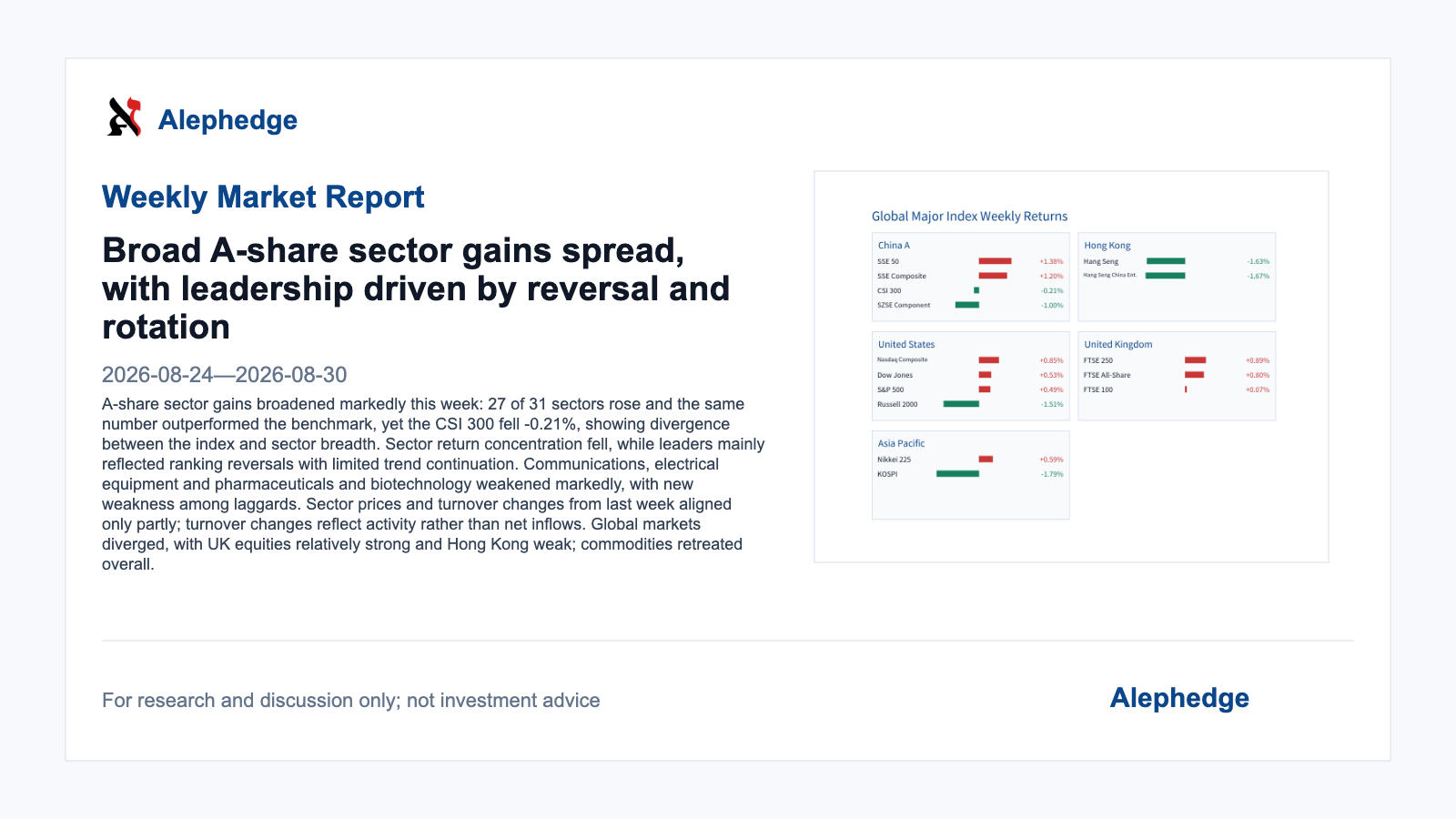
Major global markets were mixed this week. Representative UK indices all rose and ranked relatively high; most major US indices also rose. Both representative Hong Kong indices fell, while A-shares and Asia-Pacific markets diverged internally. The FTSE 250 rose +0.89% and the Nasdaq Composite +0.85%; the Hang Seng fell -1.63%, the Hang Seng China Enterprises Index -1.67% and South Korea's KOSPI -1.79%. Since index start and end dates are not fully aligned, cross-market comparisons should serve only as directional references.
Commodities retreat overall
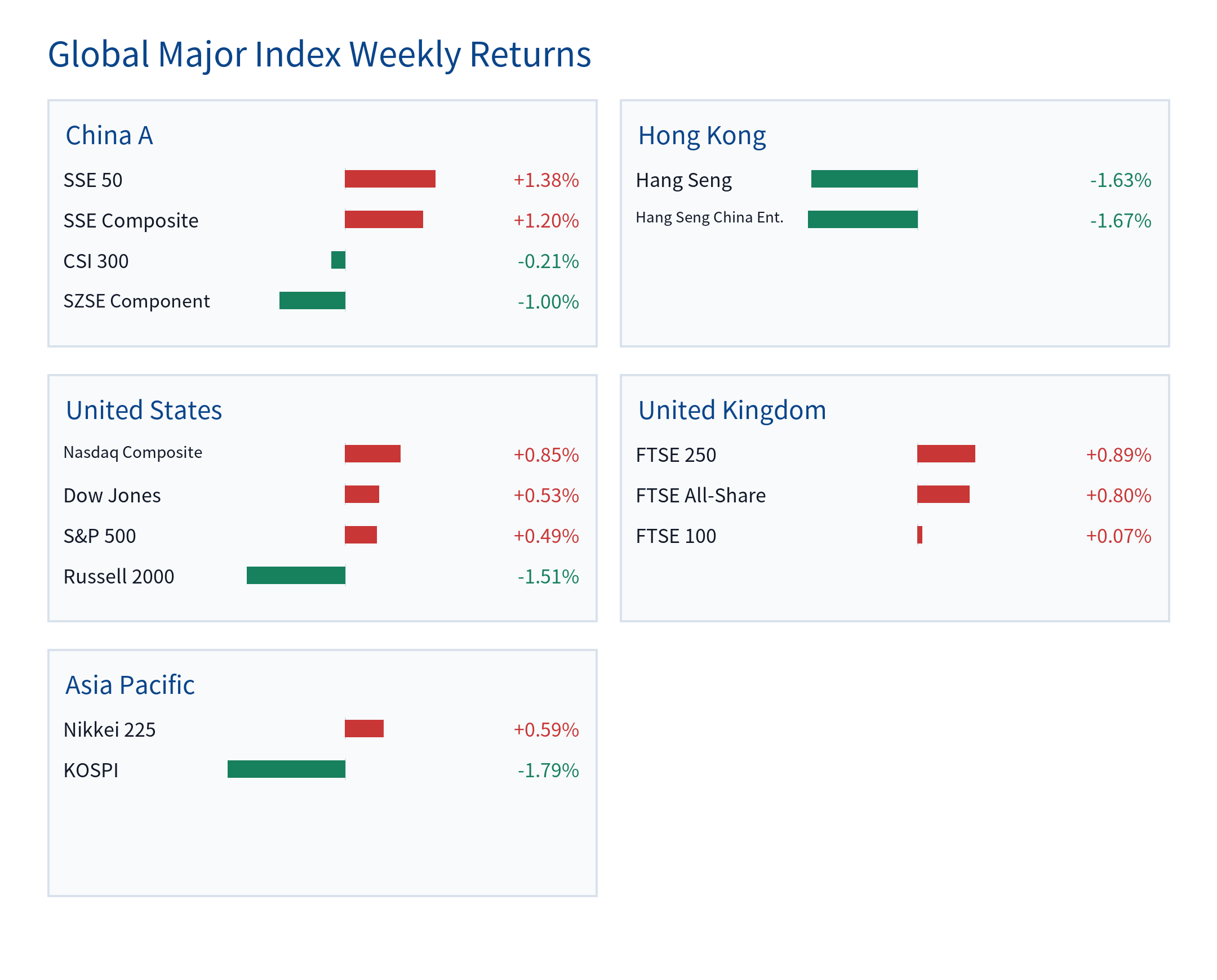
All covered commodities retreated this week, with energy falling more sharply than precious metals. Brent crude fell -5.38%; gold futures and London spot gold fell -3.16% and -3.26%; silver futures and London spot silver fell -3.56% and -3.87%. Without industrial metals data, a complete comparison within commodities remains limited.
A-share breadth improves, but leadership rotates
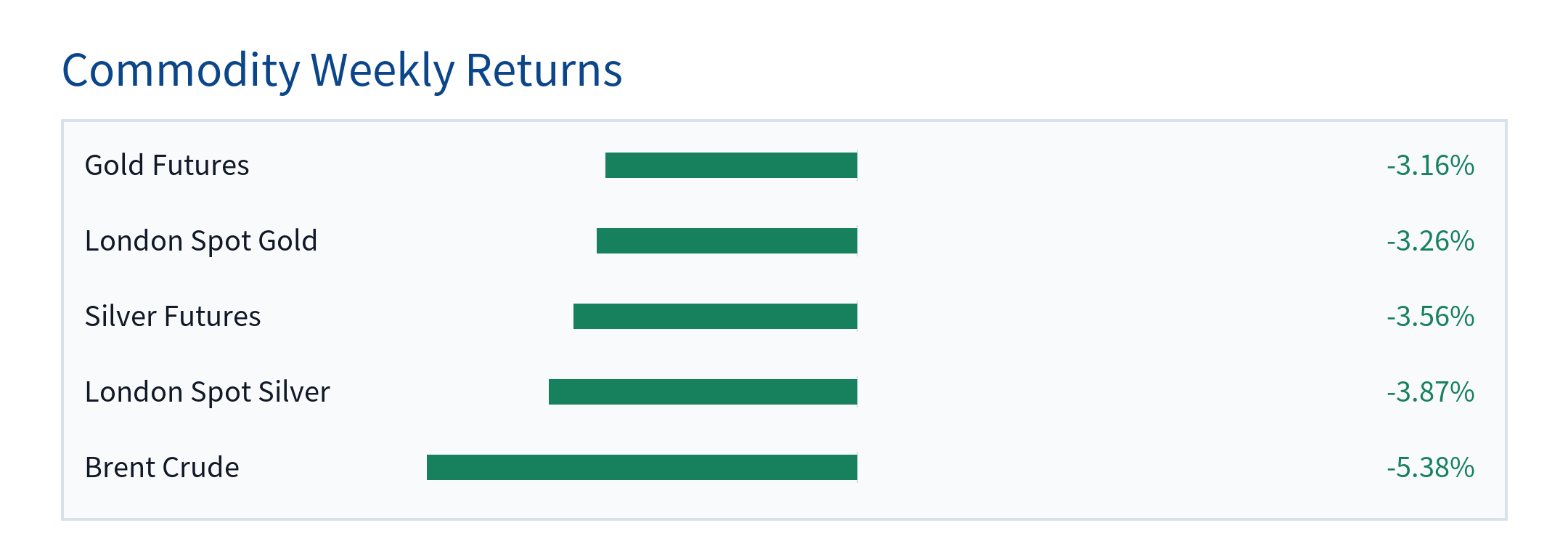
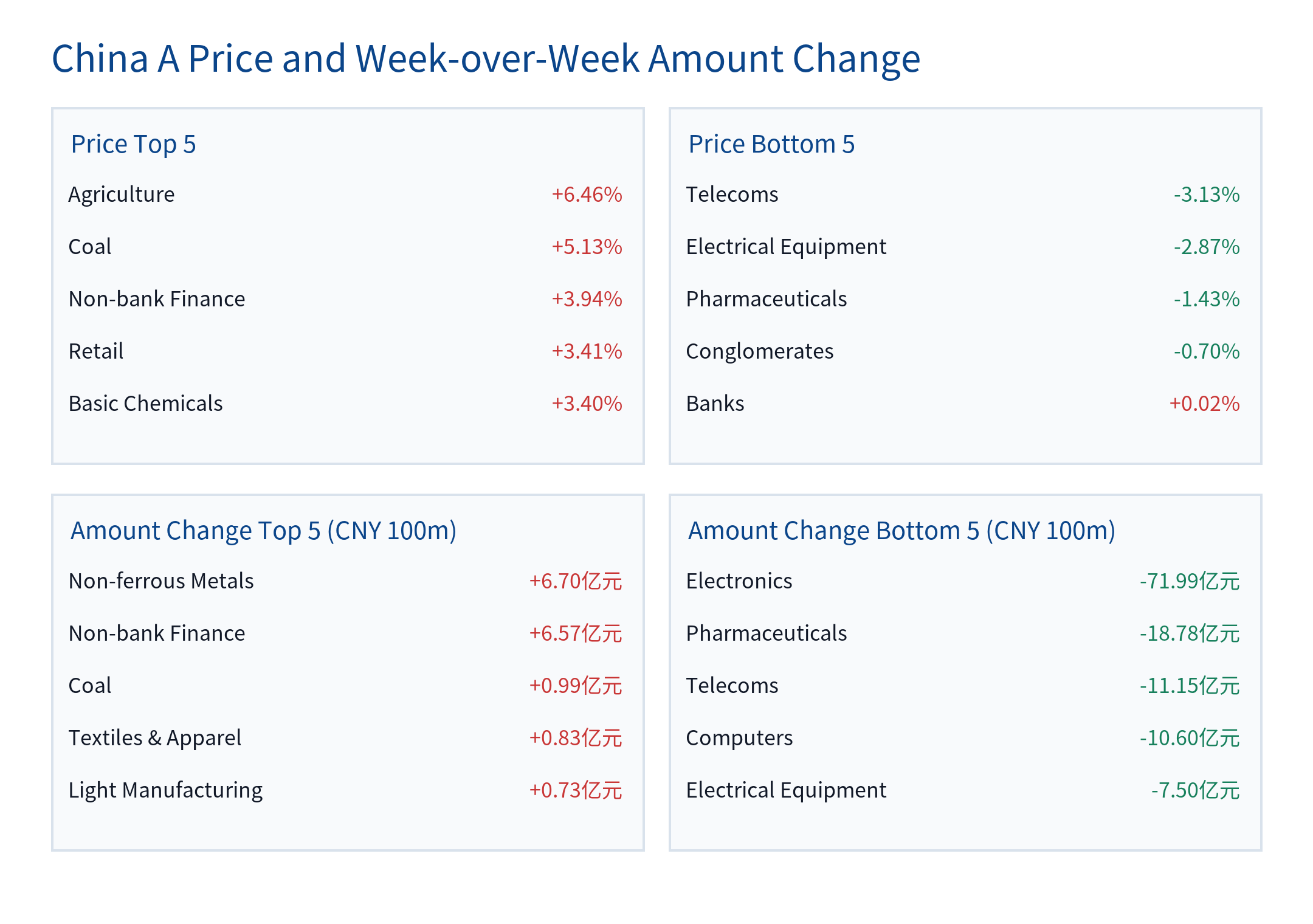
A-share sector breadth improved markedly, but leadership mainly reflected reversal and rotation rather than continued strength. Of 31 sectors, 27 rose, representing 87.1%, up 64.5% from last week's 22.6%; 27 also outperformed the benchmark, representing 87.1%, while the CSI 300 fell -0.21%. The median sector return was +1.72%, versus leading sectors' average of +5.17%. The gap was +3.46%, below last week's +4.84%, indicating lower concentration. No top-five sector was continuing previous strength; agriculture, forestry, livestock and fisheries, non-bank financials, trade and retail, and basic chemicals showed reversals. Communications, electrical equipment and pharmaceuticals and biotechnology weakened markedly, falling -3.13%, -2.87% and -1.43% respectively. Laggards included both newly weak sectors and persistent low-ranking sectors.
Prices and trading activity partly diverge
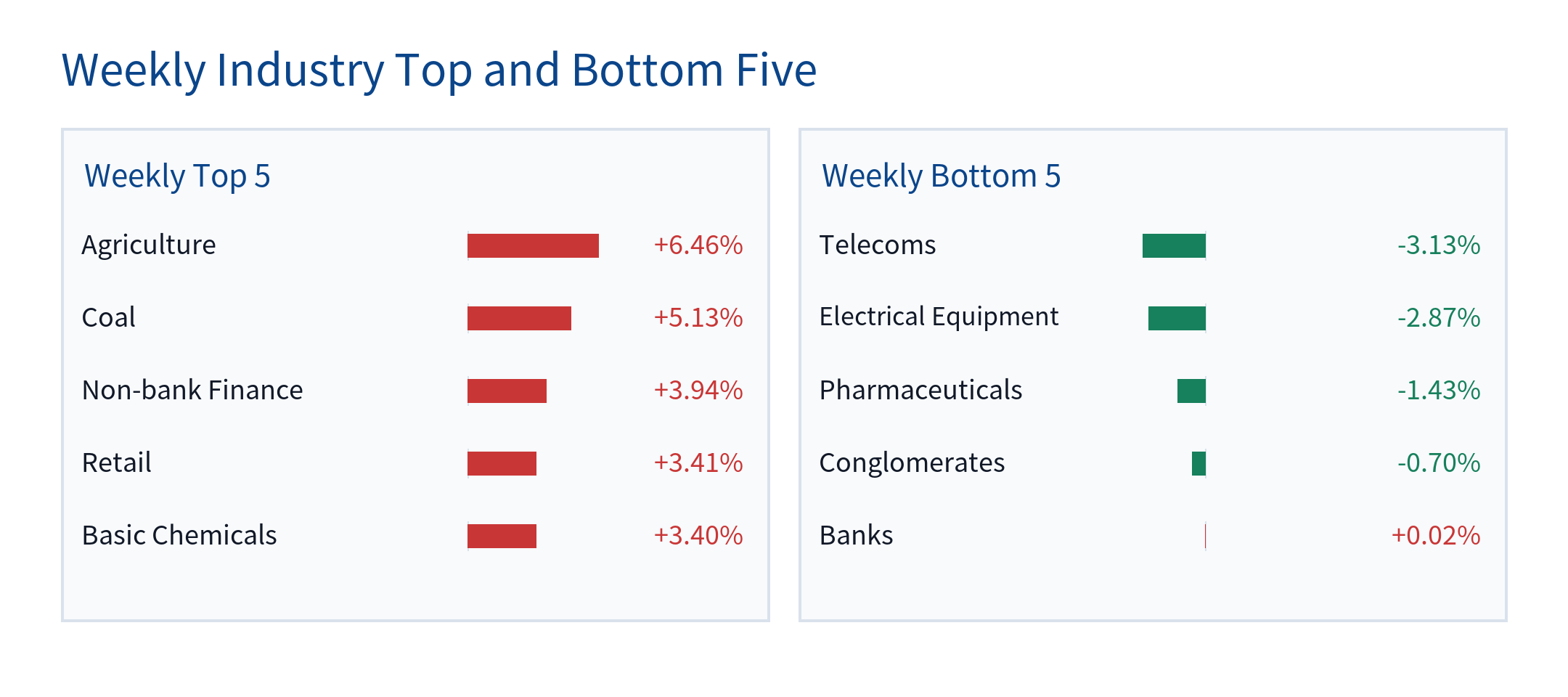
Sector price performance and turnover changes from last week aligned only partly, with no uniform price implication from activity changes. Non-bank financials rose +3.94%, with turnover up +6.57 hundred million yuan; coal rose +5.13%, with turnover up +0.99 hundred million yuan. Agriculture, forestry, livestock and fisheries and basic chemicals led in gains, but turnover fell -0.87 hundred million yuan and -3.07 hundred million yuan respectively. Electronics and IT had lower turnover but still rose slightly. Communications, electrical equipment and pharmaceuticals and biotechnology weakened on lower turnover, reflecting a simultaneous contraction in activity. Turnover changes do not represent net inflows.
What to watch
Watch whether the breadth of rising sectors and the proportion outperforming the benchmark can hold up, and whether the gap between leading sectors and the sector median continues to change. Watch whether reversal-led sectors retain their relative rankings and changes among laggards such as communications, electrical equipment and pharmaceuticals and biotechnology. Whether alignment or divergence between sector prices and turnover changes continues also remains to be seen.
Analyst's view
A-shares and Hong Kong continued to show heavyweights outperforming growth. US equities maintained weekly gains on Nvidia and leading software companies' results, but small caps and most sectors were actually weak.
AI results support the US weekly gain; Warsh's speech weighs on Friday
After Warsh's speech, expectations of rate rises heated up rapidly, turning intraday US fluctuations into broad declines. Rate-sensitive technology and small caps fell most, while the Dow was essentially flat.
US equities largely revolved around three developments this week:
Monday: semiconductors and large technology stocks fell amid concerns about US-Iran tensions, AI data-centre regulation and pressure in long-dated Treasuries.
Tuesday: lower oil prices and Treasury yields supported a technology recovery.
Wednesday: US July PCE rose 3.7% year on year, above expectations, and indices closed slightly lower.
Thursday: Nvidia's results and guidance significantly exceeded expectations, lifting the Nasdaq 1.57% and the S&P 0.72%, the week's main source of gains.
Friday: Warsh reiterated inflation control as the priority; rate-rise probabilities and short-term yields rose, and equities gave back part of Thursday's gains.
Thus, although indices all rose this week, the move was closer to a selective rally led by large AI heavyweights than a broad recovery in risk appetite.
The S&P 500 reached its highest close of 7730.99 on Thursday, retreating to 7711.76 on Friday but remaining near 7700 and ending slightly higher for the week.
The Nasdaq clearly fell early in the week, surged on Thursday and gave back part on Friday, ultimately outperforming the S&P and Dow. By contrast, the Russell 2000 fell 1.51% for the week, showing that high rates continued to constrain small and mid-cap stocks.
Only communication services, technology and financials rose among the 11 major sectors. Sharp Thursday gains in Nvidia, Salesforce and CrowdStrike largely determined the indices' positive weekly close; healthcare, industrials, energy and property were weak.
Friday reversed the pattern: information technology fell about 1.55% and semiconductors about 3.47%, while communication services, consumer discretionary and financials were relatively resilient. Alongside Warsh's speech, some chip companies' margin guidance intensified semiconductor profit-taking.
Warsh's central message can be summarised in four points:
1. The 2% PCE inflation target is clear and fixed.
2. The US economy and labour market remain solid, and overall financial conditions can hardly be described as tight.
3. PCE is still rising 3.7% year on year; inflation has improved little over the past two years, and summer data are insufficient to show a marked improvement in underlying inflation.
4. Short-term rates remain the main tool for achieving inflation and employment objectives; unconventional monetary policy should be used cautiously outside crises.
Warsh did not directly promise a September rise. He said action would still be needed if the Federal Reserve could not be confident that underlying inflation was returning to target fast enough. Markets read this as clearly hawkish; the probability of a September rise jumped from 35.4% the previous day to 55.7%.
A-shares
Shanghai rose 1.20% this week, while Shenzhen and ChiNext fell 1.00% and 3.42%. Financials, property, agriculture and some cyclicals stabilised Shanghai. Semiconductors, PCB, CPO and computing hardware fell sharply, rebounded on Nvidia's results, then retreated again on Friday.
Index performance shows continued rapid rotation between elevated technology and low-priced heavyweights. Shanghai's rise does not mean growth stocks have completed their recovery.
Hong Kong equities
The Hang Seng fell about 1.63% for the week and the Hang Seng TECH Index about 3.4%. Alibaba's 800 hundred million Hong Kong dollar placement was the week's main liquidity shock. Technology, AI applications and semiconductors fell together on Monday; pharmaceuticals, brokers, property and non-ferrous metals subsequently recovered in rotation, but the technology index never recovered its early-week losses.
Risk warning
This report is a static description of the weekly data supplied and does not constitute investment advice. Statistical periods for cross-market indices are not fully aligned, so comparisons are directional references only. Sector turnover changes from last week reflect changes in activity, not net fund inflows.