

Market Weekly · 2026-08-17—2026-08-23
2026-08-17—2026-08-23|Hong Kong strengthens as A-share sector breadth narrows
Executive summary
Markets diverged this week. Major Hong Kong indices strengthened, with the Hang Seng up 3.55%, while representative A-share, US and Asia-Pacific indices were weak overall. Major commodities generally rose, with precious metals and energy strengthening together. A-share sector breadth narrowed: only 7 of 31 sectors rose and return concentration edged higher. Petroleum and petrochemicals, non-ferrous metals and transport showed ranking reversals. Media and IT were weak, while diversified companies and food and beverages retreated markedly from last week. Prices and turnover changes aligned only partly, with divergence in some sectors. Turnover changes reflect activity only, not net fund inflows or outflows.
Global market comparison
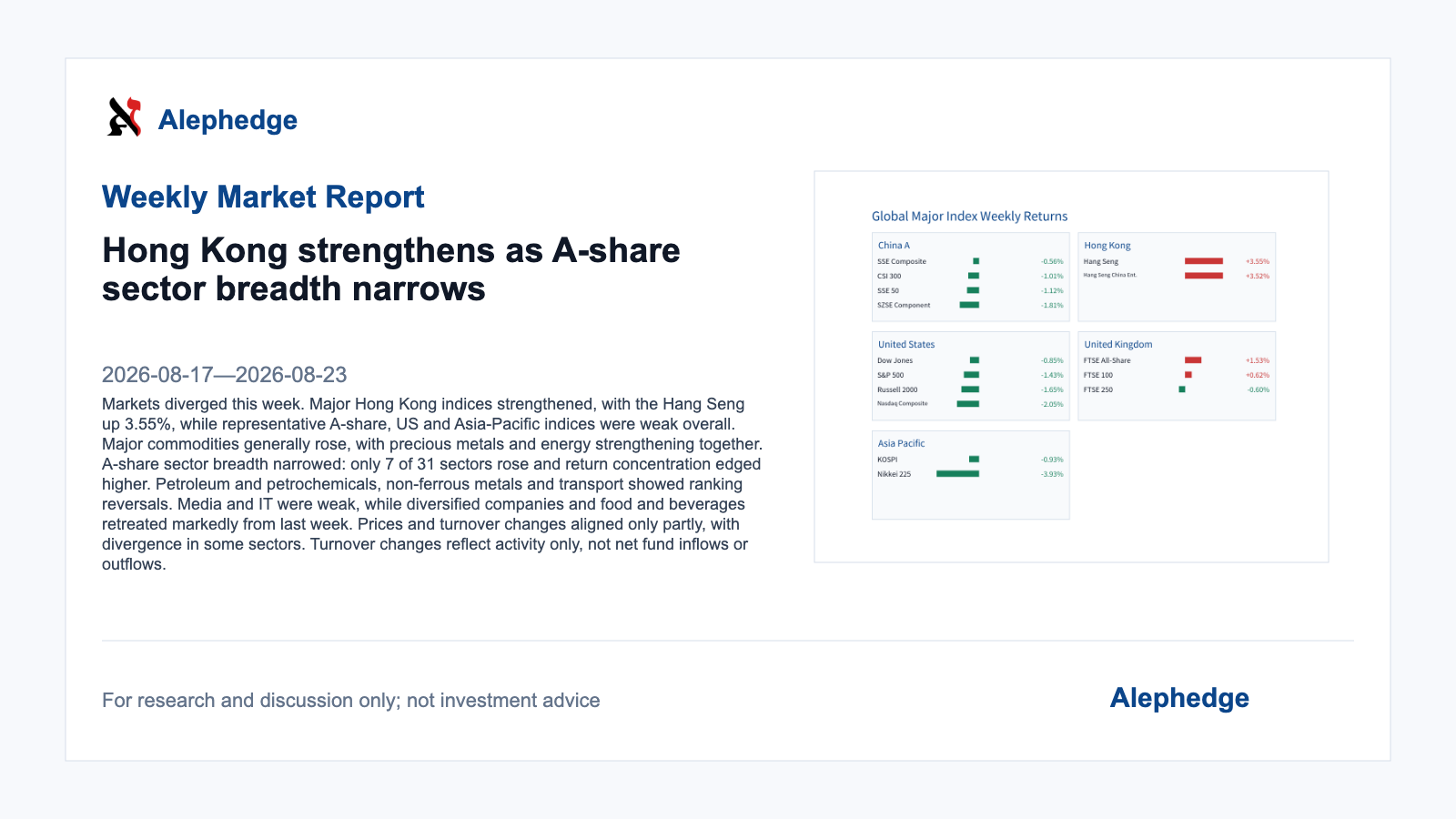
Major Hong Kong indices stood out this week, while representative A-share, US and Asia-Pacific indices were weak overall. The Hang Seng rose 3.55% and the Hang Seng China Enterprises Index 3.52%; the Shanghai Composite fell 0.56%, the CSI 300 1.01% and the Shenzhen Component 1.81%. In the US, the Dow Jones Industrial Average fell 0.85%, the S&P 500 1.43% and the Nasdaq Composite 2.05%. South Korea's KOSPI fell 0.93% and the Nikkei 225 3.93%. UK equities diverged, and the FTSE All-Share used a different statistical period, preventing strict direct comparisons with other indices.
Commodity market signals
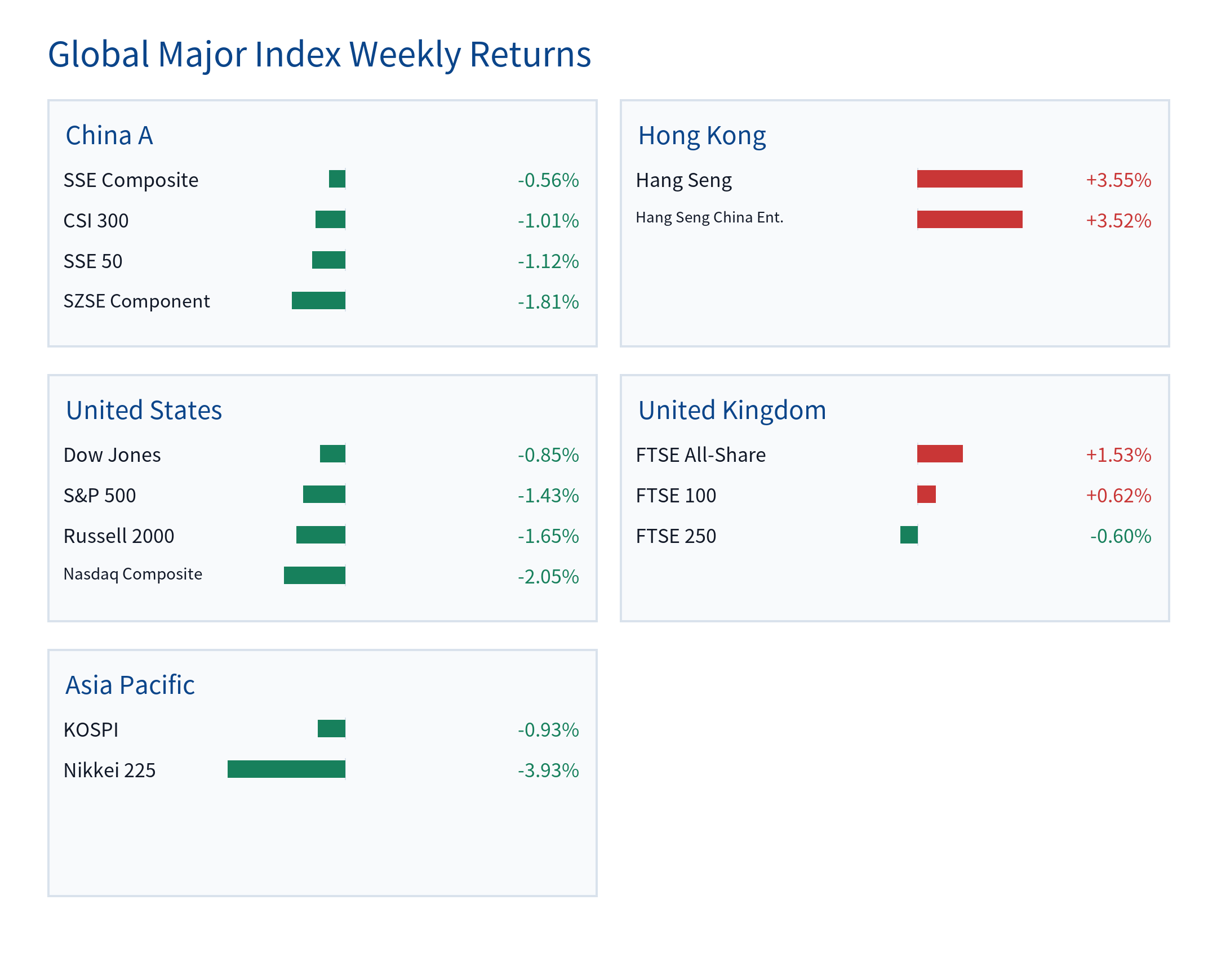
The listed major commodities rose overall, with precious metals and energy strengthening together. Silver futures rose 6.89%, London spot silver 6.64% and Brent crude 6.63%; gold futures rose 5.56% and London spot gold 5.23%. Broad commodity gains coexisted with divergent equity markets, reflecting differing weekly performance across asset classes.
A-share sector breadth, concentration and rotation
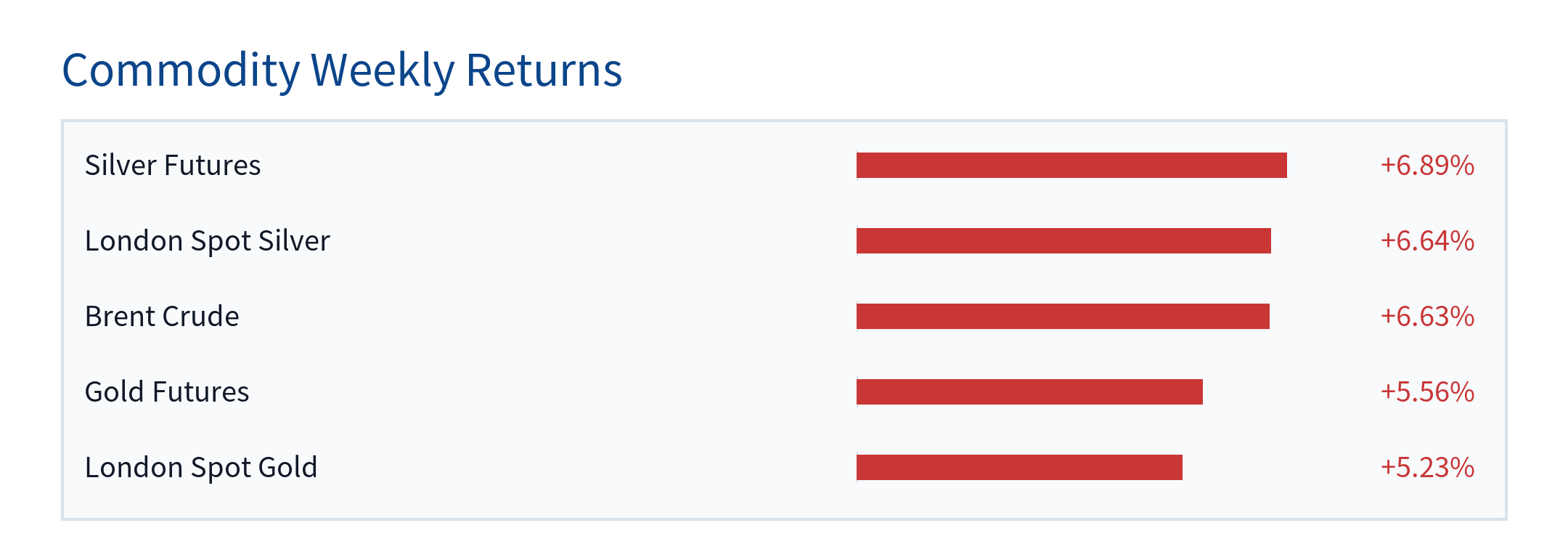
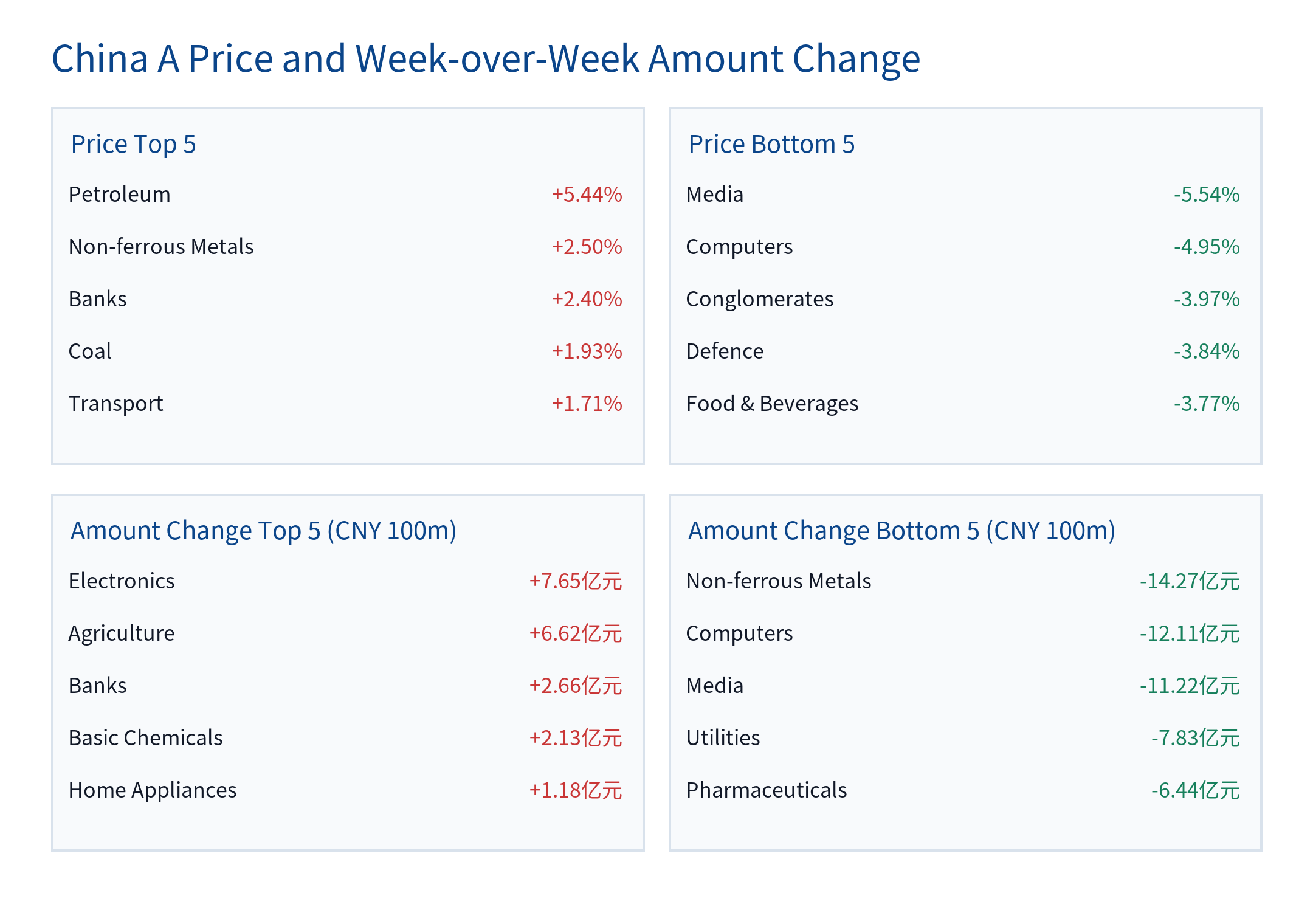
A-share sector breadth contracted markedly from last week, concentrating returns in a few sectors, with leadership mainly driven by ranking reversals. Only 7 of 31 sectors rose, giving positive-return coverage of 22.6%, down 25.8 percentage points from 48.4%. The proportion outperforming the index was 41.9%, down 29.0 percentage points from 71.0%. Leading sectors' average return was 3.45%, against a sector median of -1.39%, a gap of 4.84 percentage points, slightly above last week's 4.75 percentage points. Petroleum and petrochemicals rose 5.44%, non-ferrous metals 2.50% and transport 1.71%, all climbing from low rankings to the leaders. Media fell 5.54% and IT 4.95%, while diversified companies and food and beverages retreated markedly from leading positions, reflecting rapid shifts in sector strength.
A-share prices and turnover activity
Sector price performance and turnover changes from last week aligned only partly, with divergent activity. Banking rose on higher turnover, while IT and media fell on lower turnover. Non-ferrous metals rose despite lower turnover, while electronics fell on higher turnover. Such divergence shows that a single dimension cannot summarise weekly sector strength; turnover changes reflect activity, not net inflows.
What to watch
Watch whether next week's positive-return coverage and proportion of sectors outperforming the index continue to change. Watch the return gap between leading sectors and the median, and ranking changes in petroleum and petrochemicals, non-ferrous metals and banking. Watch whether prices and turnover changes continue to coincide or diverge, especially in banking, non-ferrous metals, electronics, IT and media.
Analyst's view
The US Treasury's expansion of long-dated bond buybacks does not equate to the Federal Reserve restarting quantitative easing. Its main role is to improve liquidity in long-dated Treasuries and reduce the risk of long-term yields briefly becoming disorderly.
The effects on major assets can be summarised as follows:
Gold: positive, benefiting from a weaker dollar and lower real rates
Equities: positive, depending on whether long-term yields can keep falling
On 19 August, the US Treasury announced that the maximum size of each buyback of nominal coupon securities with 10—20 years and 20—30 years remaining would increase from 20 hundred million US dollars to at least 40 hundred million US dollars;
Effective from 2026, 9 September, provisionally until 4 November; this increases quarterly buybacks by at least about 140 hundred million US dollars.
Why is this not substantive QE?
After buying back old debt, the Treasury must still use fiscal cash or issue new debt at other maturities to finance it, so the US government's net financing requirement is not eliminated.
Quantitative easing is conducted by the Federal Reserve and has these key features:
1. The Federal Reserve makes sustained net purchases of Treasuries or other securities;
2. Its balance sheet expands;
3. Banking-system reserves increase;
4. Purchases significantly exceed normal reinvestment needs.
Gold itself pays no interest, so its price is usually more sensitive to real rates than nominal rates.
If Treasury buybacks lift long-dated bond prices and lower nominal yields without a corresponding fall in inflation expectations, real rates fall and the opportunity cost of holding gold declines.
The transmission is:
> Long-bond buybacks → lower long-term yields → lower real rates → greater relative appeal of safe-haven assets (gold and Bitcoin)
However, this buyback announcement suppressed yields only briefly. The 30-year Treasury yield fell from near 5.34% to about 5.18%, then returned to around 5.25%, showing that the current buyback scale is insufficient to change the long-term rate trend persistently.
Effects on equity markets
1. Highly valued growth stocks: positive in theory; actual effects depend on yields
Much of the value of technology, AI, software and biotechnology companies comes from future cash flows, making them especially sensitive to long-term rates. Lower long-term yields reduce discount rates, raising the present value of future cash flows and supporting valuations in the Nasdaq, Hang Seng TECH Index, and China's ChiNext and STAR Market.
Transmission: long-bond buybacks → lower long-term yields → lower discount rates → higher growth-stock valuations.
US equities recovered only briefly. The Nasdaq still fell 2.1% for the week, showing that investors had not interpreted Treasury buybacks as sustained monetary easing.
2. Resources and real-asset sectors: relatively positive.
If investors interpret buybacks as weaker dollar credibility or greater fiscal dominance, gold, silver, copper, energy and other real assets become relatively more attractive. This is also an important reason precious metals, gold jewellery and materials strengthened simultaneously in A-share, Hong Kong and US markets this week.
These buybacks can ease valuation pressure on global equities, but are insufficient to create the liquidity environment for a broad advance.
In the short term, buybacks are more a buffer against disorderly Treasuries and forced deleveraging in financial markets. Growth-stock valuation conditions improve substantively only if long-term yields fall persistently.
Weekly market review briefing
2026, 17 August—21 August
The week's central global development was a rapid rise in long-term US Treasury yields, repricing highly valued technology assets. Funds generally rotated from technology and growth towards financials, property, gold, resources and pharmaceuticals.
A-shares: technology rises then retreats as funds turn defensive
A-shares rose then fell this week. Semiconductors, computing, communications and robotics drove an early rebound, taking the Shanghai Composite close to 4000.
Midweek, falling overseas technology stocks, rising Treasury yields and profit-taking at high prices triggered a concentrated growth correction. ChiNext and the STAR Market were markedly more volatile than Shanghai, and market turnover briefly expanded to about 2.5 trillion yuan.
Indices gradually recovered later in the week, but turnover fell to about 1.9 trillion yuan as funds shifted towards low-priced and defensive areas.
Relatively strong sectors:
Gold, silver and non-ferrous metals; pharmaceuticals and biotechnology; agriculture and grain; high-dividend sectors such as banking and coal; lithium mining and some resources.
Relatively weak sectors: semiconductors; CPO and optical communications; computing-capacity rental; robotics; gaming and elevated technology themes.
Shanghai's decline was limited, but the internal correction was substantial. The week's underlying pattern was cooling technology and growth, with rotation towards resources, pharmaceuticals and high dividends.
On macro policy, August's one-year and over-five-year LPR remained at 3.0% and 3.5%. Policy continued to emphasise fiscal spending and loan interest subsidies rather than broad rate cuts.
---
Hong Kong equities: the Hang Seng clearly outperforms the Hang Seng TECH Index
Hong Kong was the week's strongest major market. The Hang Seng rose about 3.6%, regaining 26000, while the Hang Seng TECH Index rose only about 1.2%.
The index gap shows that financials, property, insurance, gold and local blue chips mainly drove Hong Kong's gains, rather than a broad technology rally. The distribution of sector strength resembled A-shares, with some convergence under the influence of earnings season.
Hong Kong's index recovery was driven by low-valued heavyweights. The Hang Seng was strong, but the technology index remained constrained by diverging earnings and rising global long-term rates.
Hong Kong also entered a concentrated period of interim results disclosures. Investors focused markedly more on realised earnings, widening performance differences across sectors and companies.
US equities: Treasury yields constrain technology valuations
All three major US indices fell this week, with the Nasdaq falling most.
The 30-year Treasury yield briefly reached about 5.34%, its highest since 2007; the 10-year yield remained around 4.7%. Rising long-term rates raised equity discount rates, making technology and semiconductors the main areas of correction.
Rising oil prices and the Middle East situation also increased concerns about renewed inflation, preventing expectations of Federal Reserve rate rises this year from disappearing entirely.
US equities fell because of valuation adjustments caused by rising long-term Treasury yields, rather than a universal deterioration in corporate earnings. Nasdaq underperformance against the Dow reflected rotation from growth towards value and defensives.
---
The week's main events
1. The US 30-year Treasury yield rose to about 5.34%, an almost 19-year high.
2. US public debt exceeded 40 trillion US dollars, bringing fiscal sustainability back into focus.
3. The US Treasury expanded long-dated bond buybacks, but yields fell only briefly.
4. Federal Reserve minutes continued to focus on inflation risks, with some officials supporting rate rises.
5. International oil prices rose over 5%, intensifying energy-inflation concerns.
6. Gold rose about 5% to 6%, making precious metals a strong area globally.
7. China's August LPR remained unchanged, with policy still favouring fiscal action.
8. Hong Kong entered a concentrated interim results period, with low-valued heavyweights clearly outperforming technology and growth.
Risk warning
This report describes market performance and turnover changes during the reporting week and does not constitute investment advice. Past or single-week performance does not represent future results. Sector prices and turnover changes can reverse rapidly, and turnover changes do not represent net fund inflows.