

Market Weekly · 2026-08-03—2026-08-09
2026-08-03—2026-08-09|A-shares rise as sector breadth contracts and returns concentrate in rotating leaders
Executive summary
A-shares rose this week, but sector breadth and the proportion outperforming the CSI 300 both contracted. The return gap between leading sectors and the sector median widened to 8.82%, concentrating returns further in a few rotating leaders. Electronics, communications and machinery jumped from low rankings to the top, while banking, food and beverages and home appliances recently weakened; non-bank financials remained relatively low-ranking. Major A-share and US indices rose, while Hong Kong weakened; precious metals rose and Brent crude fell. A-share sector price strength broadly aligned with turnover changes, but turnover changes do not equal net inflows.
Global equity market comparison
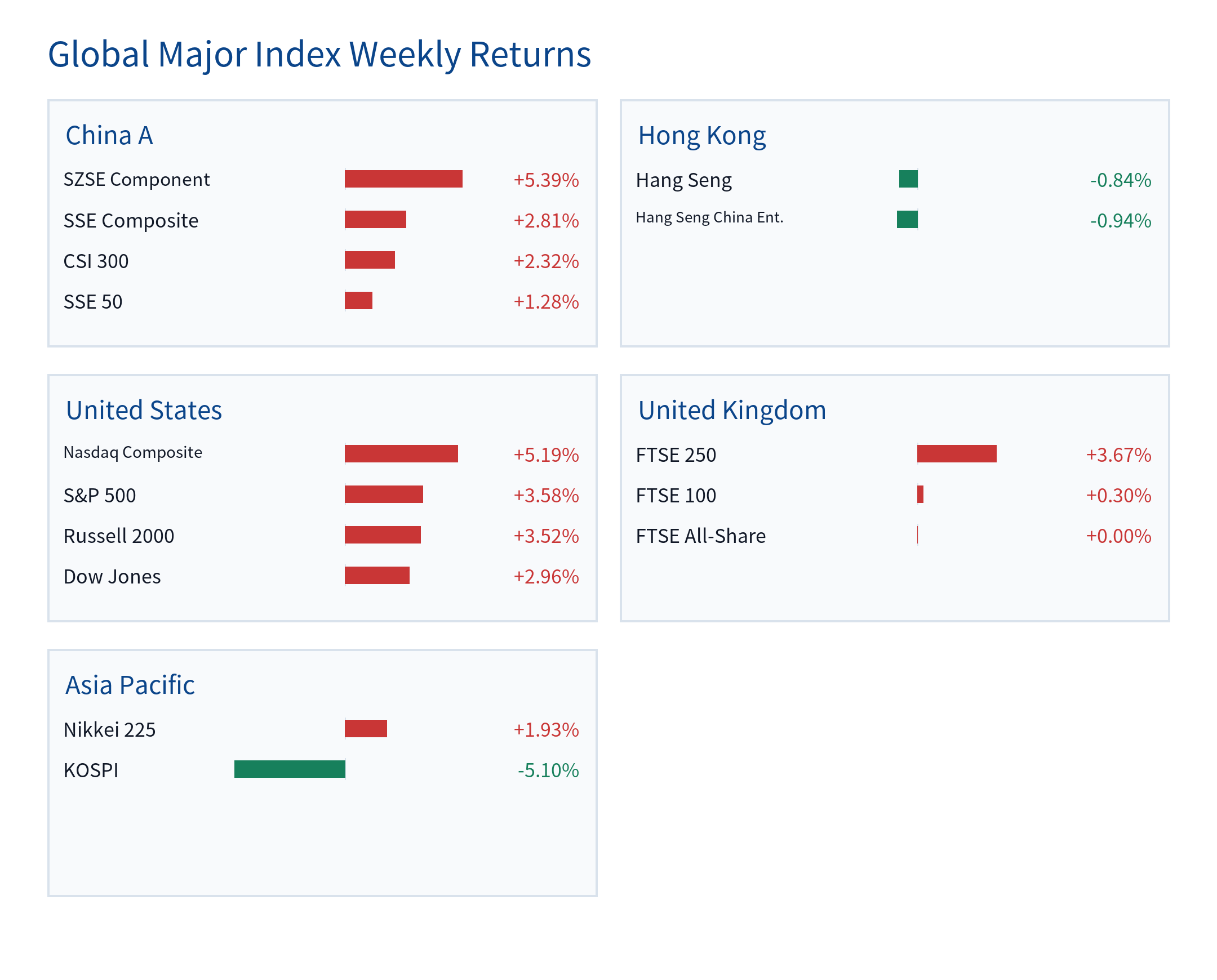
Major A-share and US indices all rose and were strong overall; major Hong Kong indices fell and Asia-Pacific markets diverged. In A-shares, the Shenzhen Component rose 5.39%, the Shanghai Composite 2.81% and the CSI 300 2.32%; in the US, the Nasdaq Composite rose 5.19% and the S&P 500 3.58%. By contrast, the Hang Seng fell 0.84% and South Korea's KOSPI 5.10%, showing marked weekly differences across markets.
Commodity signals
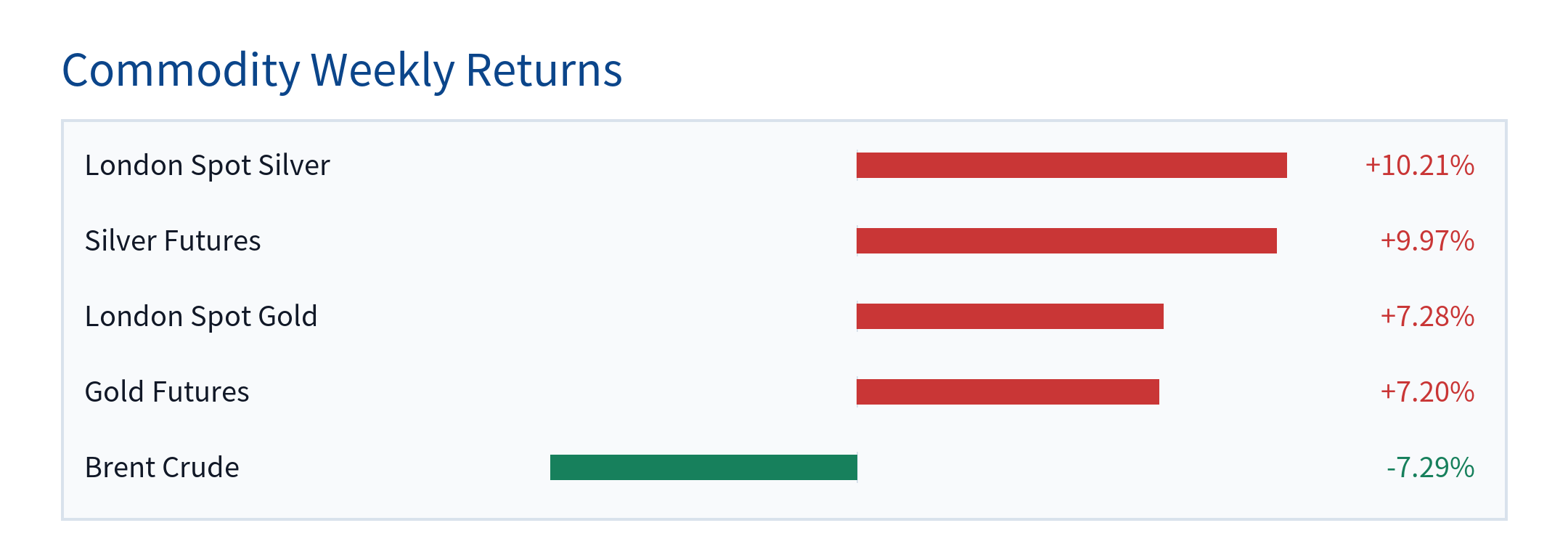
Commodities diverged this week, with sharp precious metals gains and lower Brent crude. London spot silver rose 10.21%, silver futures 9.97% and London spot gold 7.28%; Brent crude fell 7.29%. These changes reflect divergence between products, but available data cannot establish the drivers.
A-share market structure and sector rotation
A-share sectors rose overall, but breadth contracted and return concentration increased. Of 31 sectors, 22 rose, representing 71.0%, down 19.4 percentage points; 15 outperformed the CSI 300, representing 48.4%, down 45.2 percentage points. Leading sectors' average return was 11.09%, against a sector median of 2.27%, a gap of 8.82%, widening 1.54 percentage points and concentrating leading returns further in a few sectors.
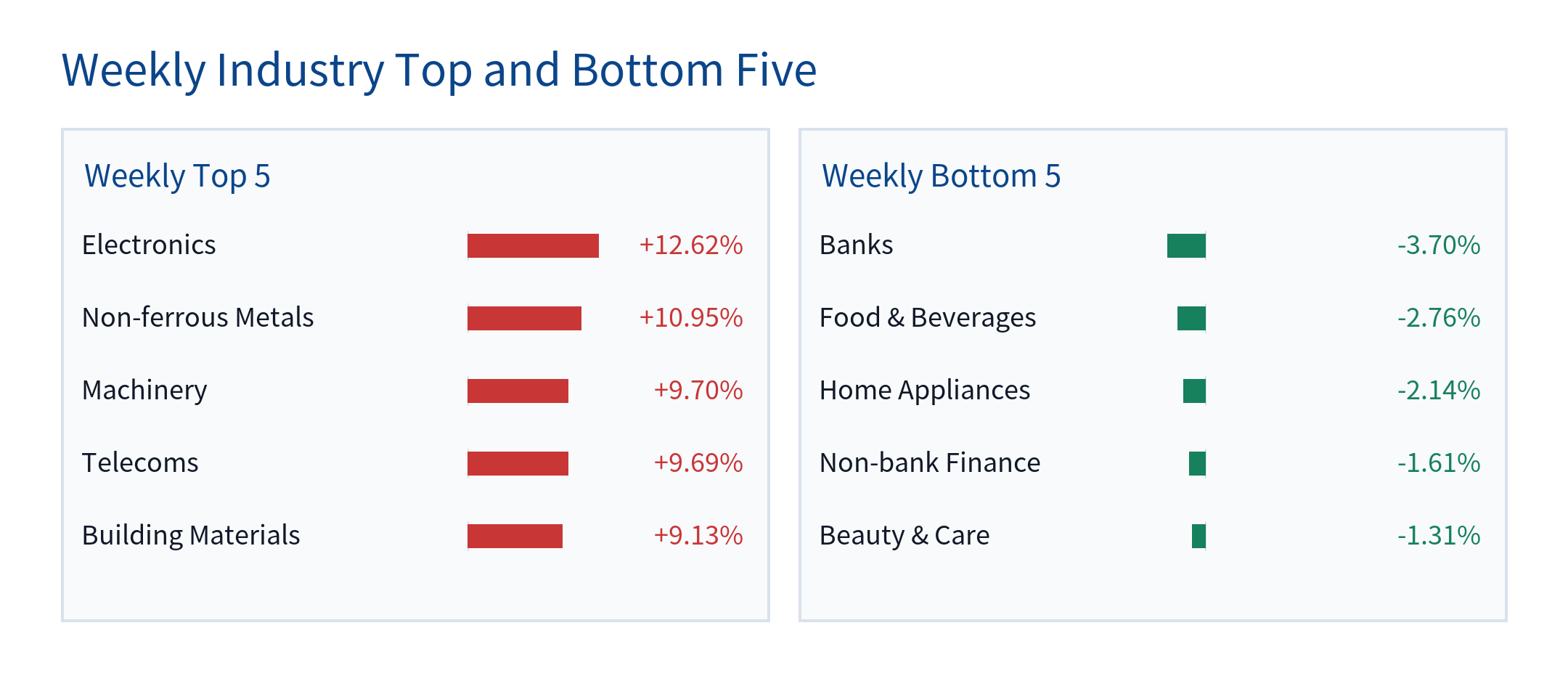
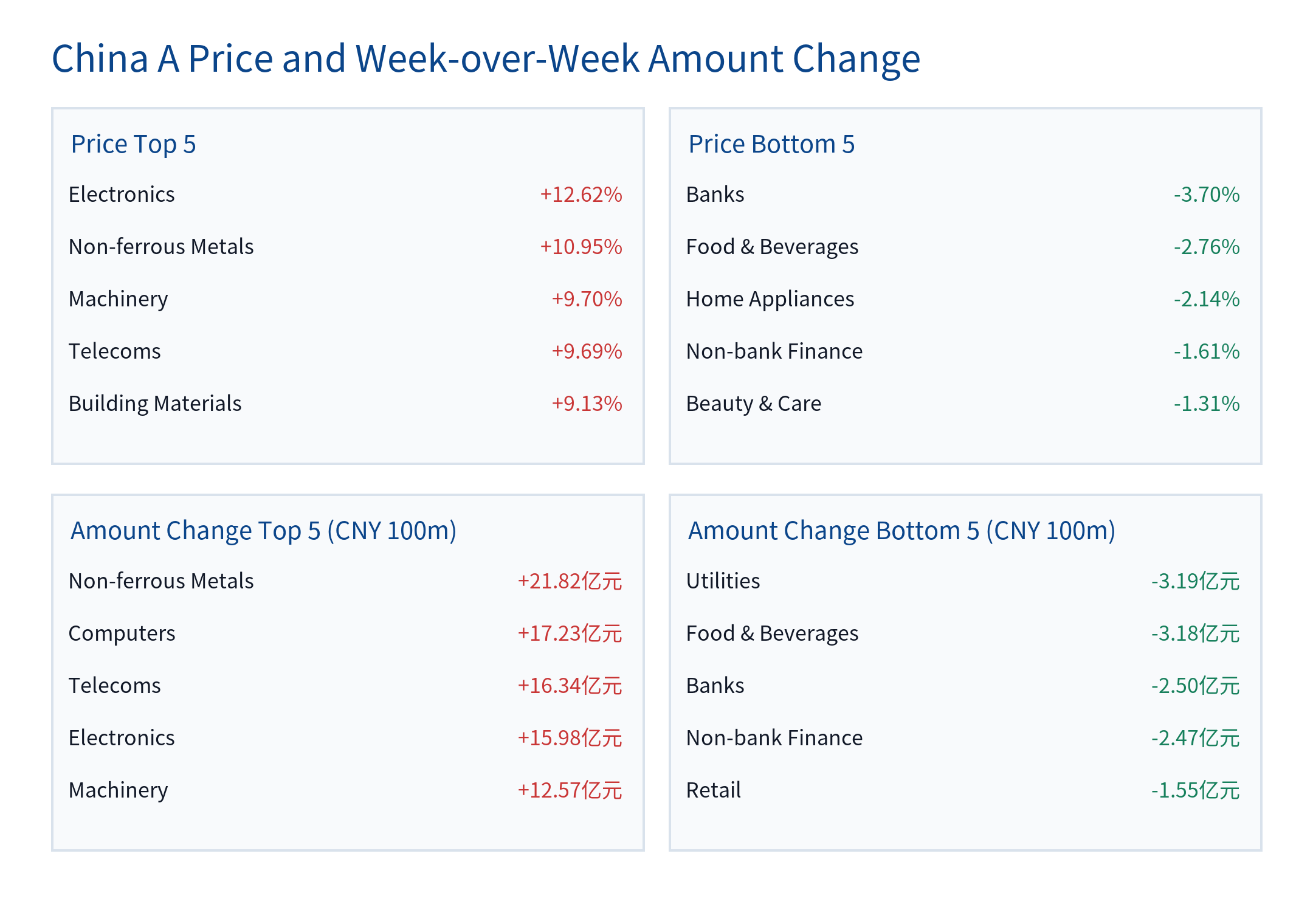
Leadership showed weekly rotation. Electronics rose 12.62%, moving from 30th to first; machinery rose 9.70%, from 29th to third; communications rose 9.69%, from 31st to fourth. Meanwhile, banking fell 3.70%, food and beverages 2.76% and home appliances 2.14%, all near the bottom of this week's rankings; non-bank financials fell 1.61%, remaining relatively low-ranking.
A-share prices and trading activity
Sector price strength broadly aligned with turnover changes, though not completely. Non-ferrous metals, communications, electronics and machinery led gains, all on higher turnover. Non-ferrous metals rose 10.95%, with turnover up 21.82 hundred million yuan; electronics rose 12.62%, with turnover up 15.98 hundred million yuan. Food and beverages, banking and non-bank financials were weak and had lower turnover.
Trading-activity changes showed some consistency across strong and weak sectors, but turnover increases or decreases from last week do not equal net inflows or outflows.
What to watch
Watch changes in the proportions of sectors rising and outperforming the CSI 300, and in the return gap between leaders and the median, to track breadth and concentration. Continue watching rankings among this week's leaders, including electronics, communications, machinery and non-ferrous metals, and the relative positions of banking, food and beverages, home appliances and non-bank financials. Observe whether sector prices and turnover changes remain aligned, distinguishing turnover changes from net-inflow data.
Analyst's view
Market review: 2026, 3 August—7 August
Last week's central global feature was a marked recovery in risk appetite, but market performance differed.
US equities broke to record highs on employment data, lower oil prices and corporate results; A-shares saw a concentrated technology and growth rebound; Hong Kong indices continued consolidating around 26000, while AI, PCB, innovative drugs and gold were active.
🇺🇸 US equities: three major indices surge as the S&P reaches a record high
All three major US indices rose last week:
The S&P 500 closed at 7757.64, up 3.58% for the week.
The Nasdaq Composite closed at 26690.62, up 5.19% for the week.
The Dow Jones Industrial Average closed at 54036.93, up 2.96% for the week.
The S&P 500 reached a record closing high on Friday, and all three indices recorded their largest weekly gains since April.
On Monday, signs of easing US-Iran tensions and sharply lower international oil prices drove broad US gains. The Dow rose about 1.3%, the S&P 500 about 1.5% and the Nasdaq about 2.1%. Amazon's market capitalisation exceeded 3 trillion US dollars for the first time, with AI and large technology stocks leading the day.
On Tuesday, corporate results and AI investment expectations kept lifting markets. The S&P 500 briefly exceeded 7700, while the Dow repeatedly reached new highs.
Divergence began on Wednesday. Although AMD, SpaceX and others reported growth figures, high valuations and capital-expenditure concerns weighed on their shares. The Dow kept rising, while the S&P 500 and Nasdaq retreated.
On Thursday, markets digested earnings. AppLovin, Datadog, Western Digital and SanDisk fell, and the three major indices corrected slightly.
On Friday, US non-farm payrolls were far below expectations, Treasury yields fell and technology strengthened again. The S&P 500 rose 0.62%, the Nasdaq 1.30% and the Dow 0.28%.
US technology was strong overall last week, with funds mainly concentrated in:
Palantir rose nearly 40% over the week on earnings; Coherent also gained over 40%, with optical communications benefiting from rising data-centre demand; Nvidia gained over 10%.
Memory lagged relatively. Western Digital and SanDisk fell markedly after results, showing disagreement over the memory-price cycle, future margins and their earlier substantial gains.
A-share technology rebounds together as ChiNext and STAR indices lead clearly
All major A-share indices rose last week:
The Shanghai Composite closed at 3940.04, up 2.81% for the week.
The Shenzhen Component closed at 14311.01, up 5.39% for the week.
The ChiNext Index closed at 3563.12, up 6.55% for the week.
The STAR 50 closed at 1744.02, up 6.61% for the week.
On Monday, A-shares continued July-end selective corrections. Technology remained sharply divided, and previously strong areas such as memory chips stayed under pressure.
On Tuesday, the rebound accelerated markedly. The Shenzhen Component rose 3.25%, ChiNext 5.64% and the STAR 50 4.09%. CPO, memory chips and CRO rebounded together, with over 3600 stocks rising market-wide.
From Wednesday to Thursday, technology and growth kept recovering, but rapid rotation began within the market. Non-ferrous metals, machinery, building materials and pharmaceuticals strengthened in succession.
On Friday, the Shanghai Composite rose 1.02%, the Shenzhen Component 1.42%, ChiNext 1.35% and the STAR 50 2.51%. Total market turnover was about 2.68 trillion yuan, with over 2800 stocks rising. Pharmaceuticals, innovative drugs, CRO, PCB and semiconductor materials stood out.
PCB, copper-clad laminates, CPO, optical modules and semiconductor materials were the main areas of last week's technology rebound.
Semiconductor equipment, chip materials and some memory-chip stocks rebounded, but memory remained sharply divided. Some previously strong memory leaders continued to see outflows during the rebound.
Resources including gold, copper, cobalt and tungsten hexafluoride rose with commodity prices,
Previously strong high-dividend sectors such as banking and insurance corrected, among the few areas to fall overall last week.
Of last week's leading stocks, more than half had fallen over 30% cumulatively in July. The main feature was therefore a broad recovery in oversold technology and small and mid-cap stocks.
Reports emerged that the US FCC might restrict imports of some Chinese optical-module products. Meanwhile, China announced stronger export controls on drones and related key components and technologies, increasing communications and hardware volatility.
As A-shares entered the concentrated half-year results period, innovative drugs, electronics, communications and machinery began repricing around expectations for orders, revenue and profit.
Major Hong Kong indices diverged last week:
The Hang Seng closed at 25668.03, down 0.84% for the week.
The Hang Seng TECH Index closed at 4858.29, up 0.60% for the week.
On Monday, the Hang Seng rose 0.48% to 26009.40, regaining 26000. The Hang Seng TECH Index rose 0.96%, with Alibaba, Tencent, Baidu, Lenovo and MINIMAX generally higher.
Over subsequent sessions, the Hang Seng failed to keep breaking above 26000. Internet platforms, financials and some local property stocks retreated.
MINIMAX-W rose over 40% for the week, becoming one of Hong Kong's strongest AI companies. It formally entered Stock Connect on 6 August and received nearly 27 hundred million Hong Kong dollars of net southbound buying on its first effective day.
On Friday, Zhipu rose 14.63% and MINIMAX-W 9.83%. DeepSeek's planned API service price increases drew attention to monetisation and changing pricing structures in China's large-model industry.
Tongguan Gold rose over 35% for the week, with gold and resources following international gold prices higher. Materials was one of Hong Kong's best-performing sectors last week.
Alibaba, Tencent and Baidu rose markedly on Monday but then traded sideways. On Friday, Tencent closed at 478.80 Hong Kong dollars, down 0.08%; Alibaba closed at 123.80 Hong Kong dollars, also failing to follow the Hang Seng TECH Index markedly higher. In earnings season, greater care is needed over the index volatility caused by heavyweight technology and internet stocks.
Banking, telecoms and insurance were relatively quiet overall. On Friday, China Mobile fell 0.67%, Bank of China 0.95%, China Construction Bank 0.79% and ICBC 0.83%.
The Hang Seng fell over the week but the Hang Seng TECH Index rose slightly, while AI applications, PCB, innovative drugs and individual gold stocks gained substantially. Indices and individual stocks diverged markedly.
DeepSeek announced plans to adjust API service prices, prompting attention to a shift in China's large-model industry from low-price competition towards monetisation, model capabilities and efficiency in generating revenue.
Risk warning
This report describes only the market prices, sector returns and turnover changes supplied for the reporting week and does not constitute investment advice. Weekly performance, sector rankings and turnover changes can reverse rapidly; turnover changes do not equal net fund inflows or outflows.