

Market Weekly · 2026-06-08—2026-06-14
2026-06-08—2026-06-14|A-share sector participation narrows further, with leaders mainly driven by ranking reversals
Executive summary
External equity markets diverged this week: the listed US and UK indices rose overall, while listed Hong Kong and Asia-Pacific indices fell overall; major A-share indices were mixed. Commodities were weak overall, with Brent crude falling most. Fewer A-share sectors rose or outperformed the benchmark than last week. Returns remained concentrated in a few sectors, with leaders mainly driven by ranking reversals. Media, IT and automotive remained weak; coal and communications newly weakened. Some leading sectors' price rises coincided with higher turnover, but the relationship was not consistent across all sectors.
Comparing global equity markets
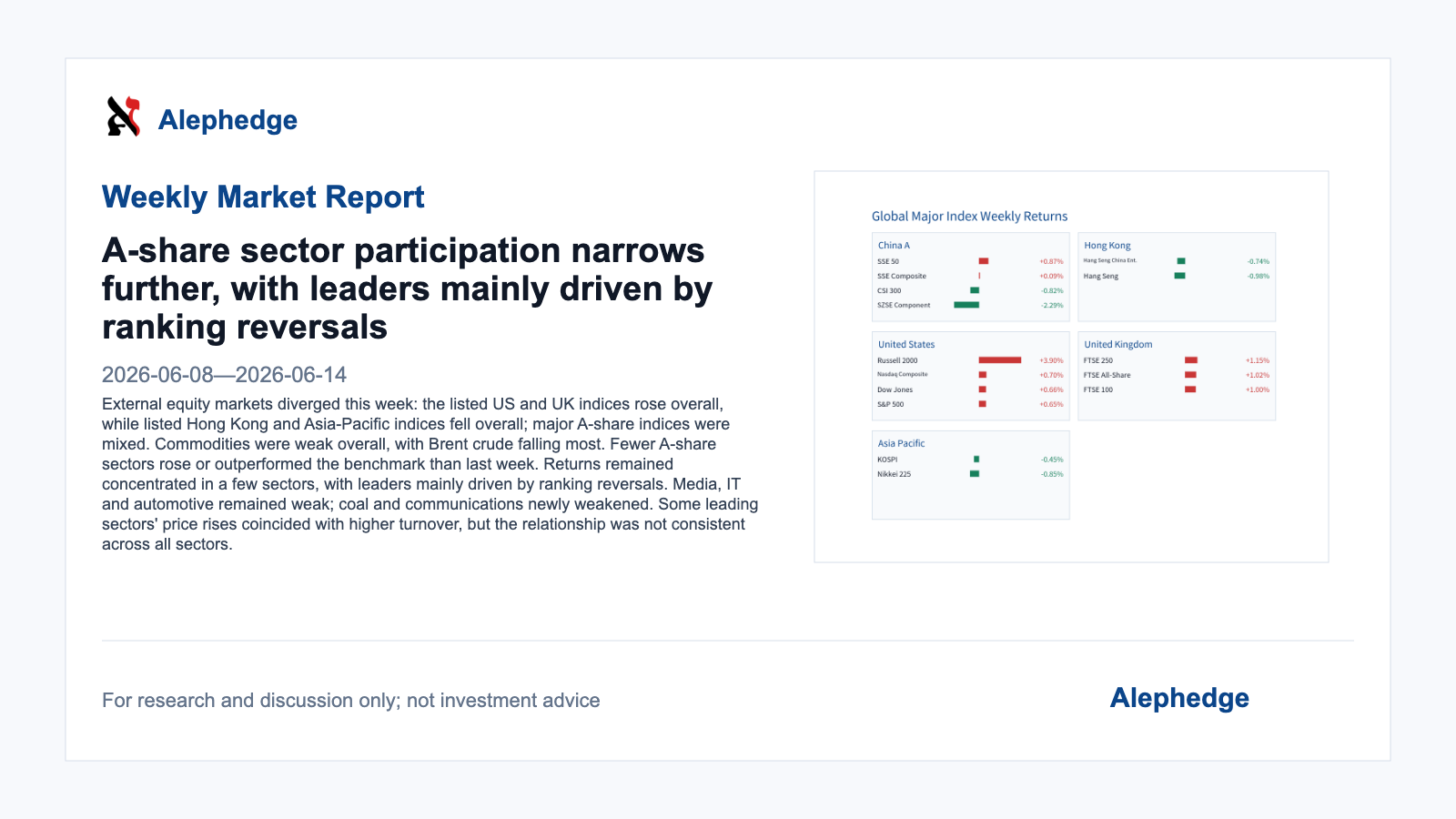
Global equities diverged by region. The listed US and UK indices rose overall, while Hong Kong and listed Asia-Pacific indices weakened overall. In the US, the Russell 2000 rose +3.90%, the Nasdaq Composite +0.70%, the Dow Jones Industrial Average +0.66% and the S&P 500 +0.65%; all listed UK indices also rose. Major A-share indices diverged: the SSE 50 rose +0.87% and the Shanghai Composite +0.09%, while the CSI 300 fell -0.82% and the Shenzhen Component -2.29%. The Hang Seng, Hang Seng China Enterprises Index and listed Japanese and South Korean indices all fell. Without aggregate returns for market groups, a strict ranking of strength across markets is impossible.
Commodity signals
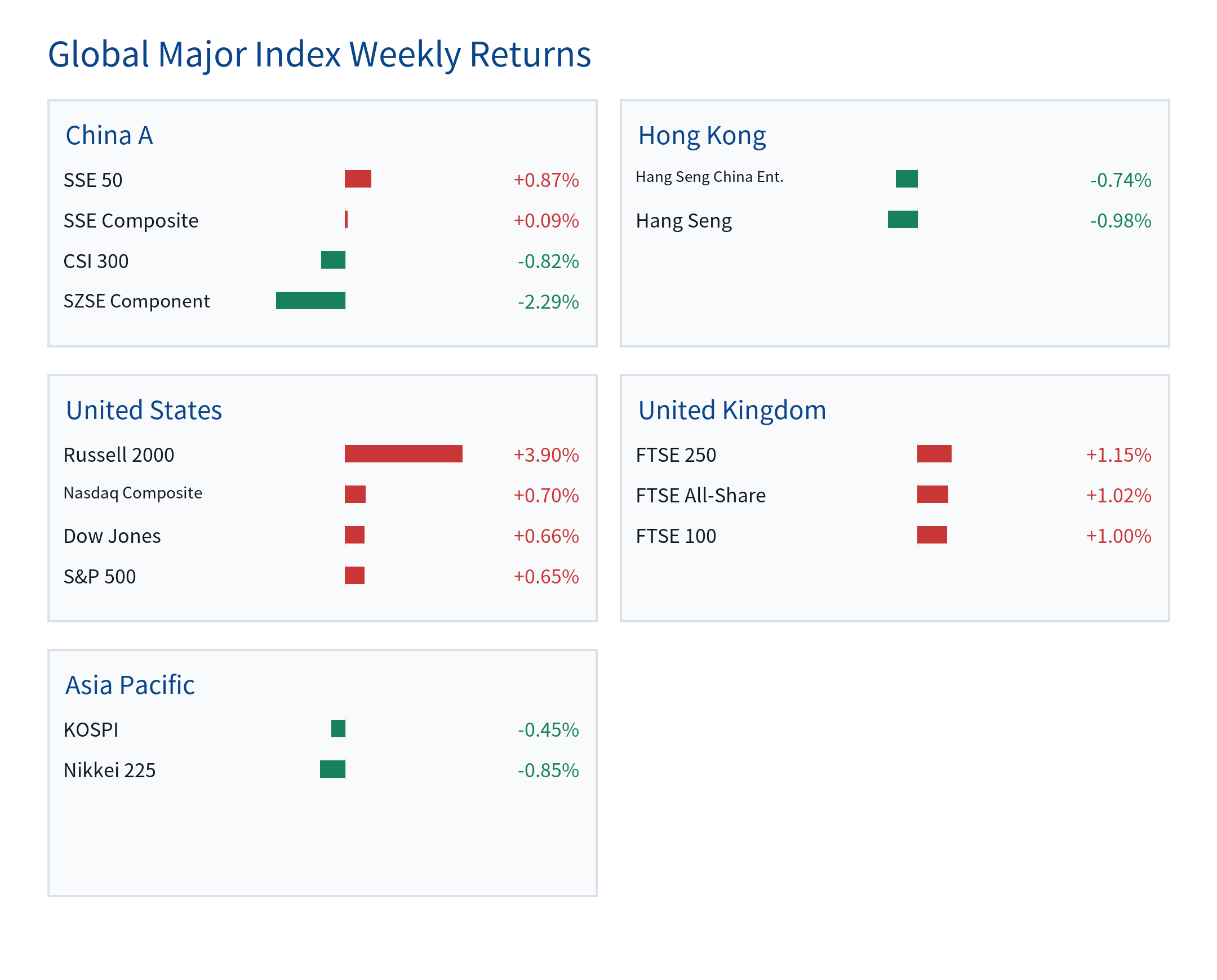
Listed commodities were weak overall, with energy falling most and most precious metals lower. Brent crude fell -6.19%, the largest listed commodity decline; gold futures fell -2.82%, London spot gold -2.56% and silver futures -1.57%. Only London spot silver edged up +0.13%. Industrial metals are not covered, so their relative performance against other commodity groups cannot be compared.
A-share breadth, concentration and sector rotation
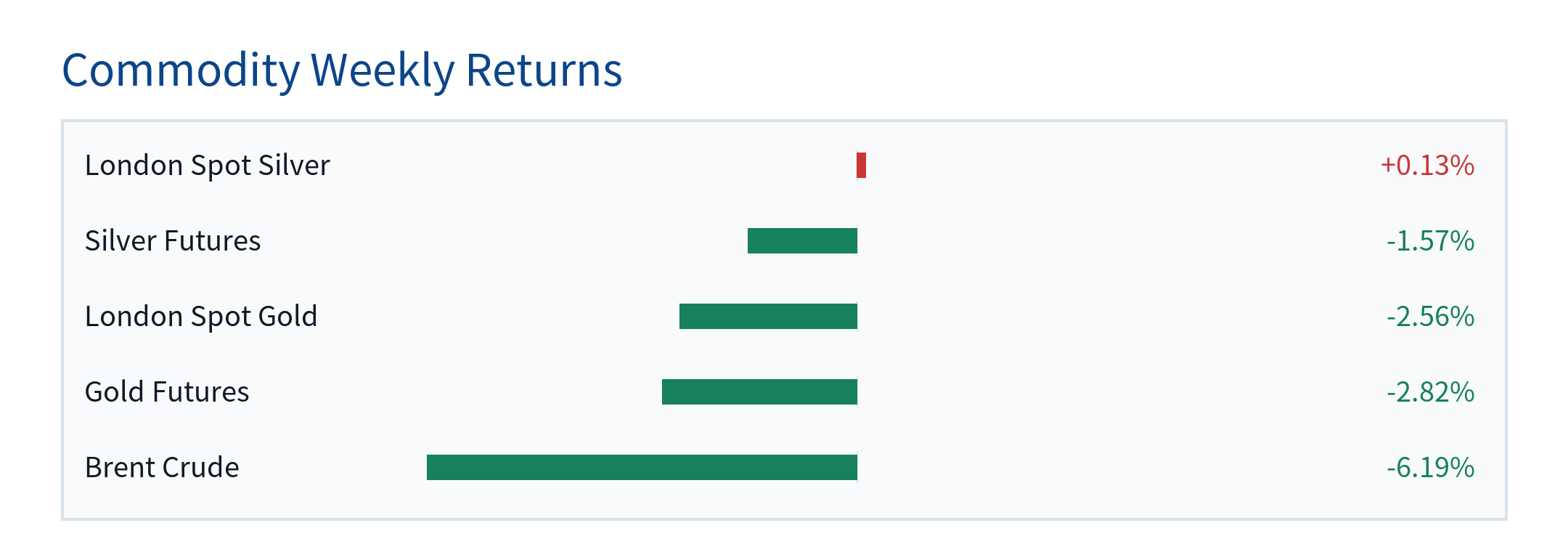
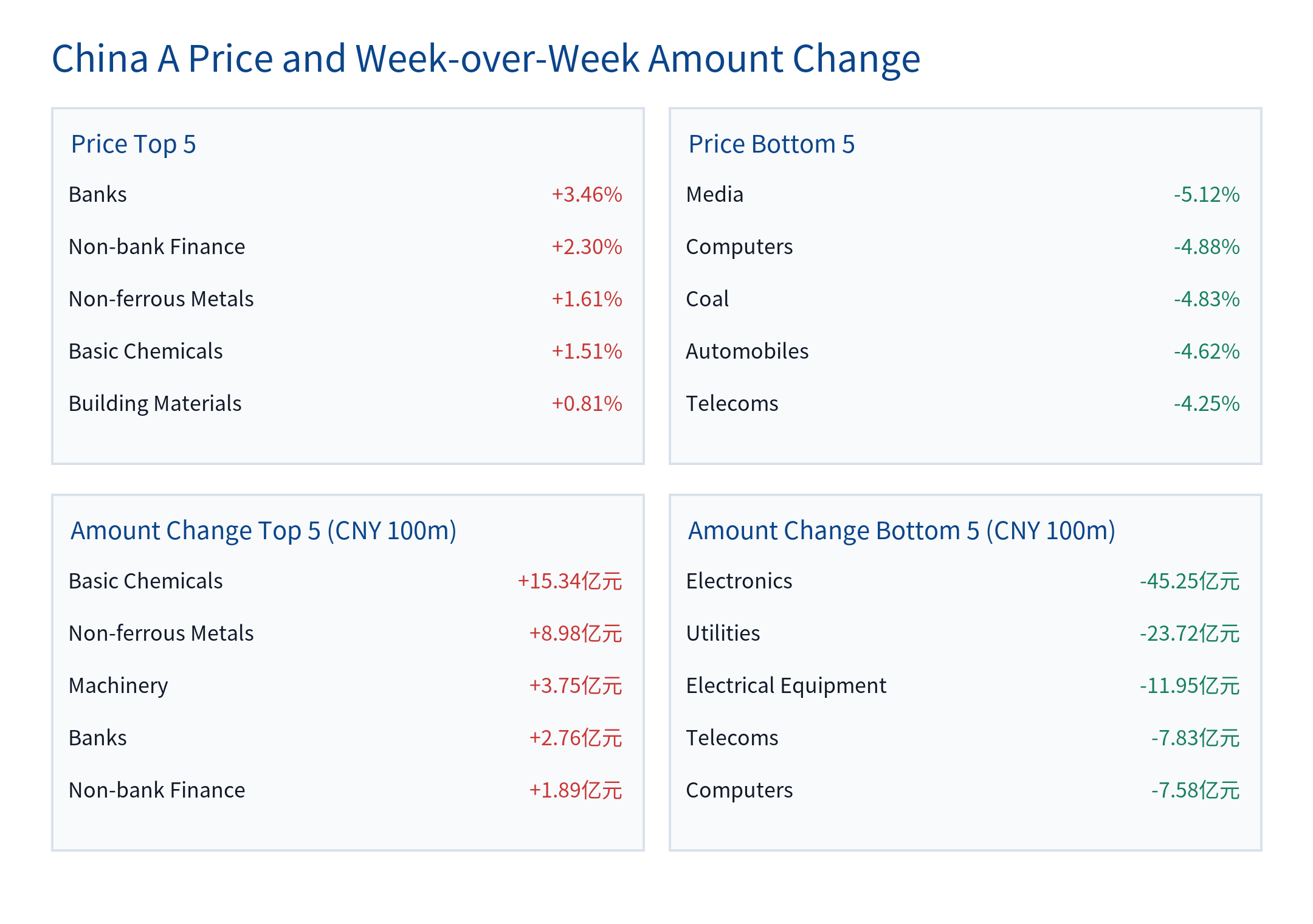
A-share sector breadth contracted further, with returns still concentrated in a few sectors, although the leaders' return gap against the median narrowed. Only 6 of 31 sectors rose, down from 7; the number outperforming the benchmark fell to 10 from 13. Leading sectors' average return was +2.45%, exceeding the median sector return by +4.36%, still indicating concentration but below last week's +5.93%. Leadership mainly reflected ranking reversals: non-bank financials, non-ferrous metals, basic chemicals and building materials all reversed, while banking continued its strength. Building materials climbed from 30th to fifth. Meanwhile, media, IT and automotive remained weak; coal and communications weakened, falling from first and second respectively to 29th and 27th.
A-share sector prices and trading activity
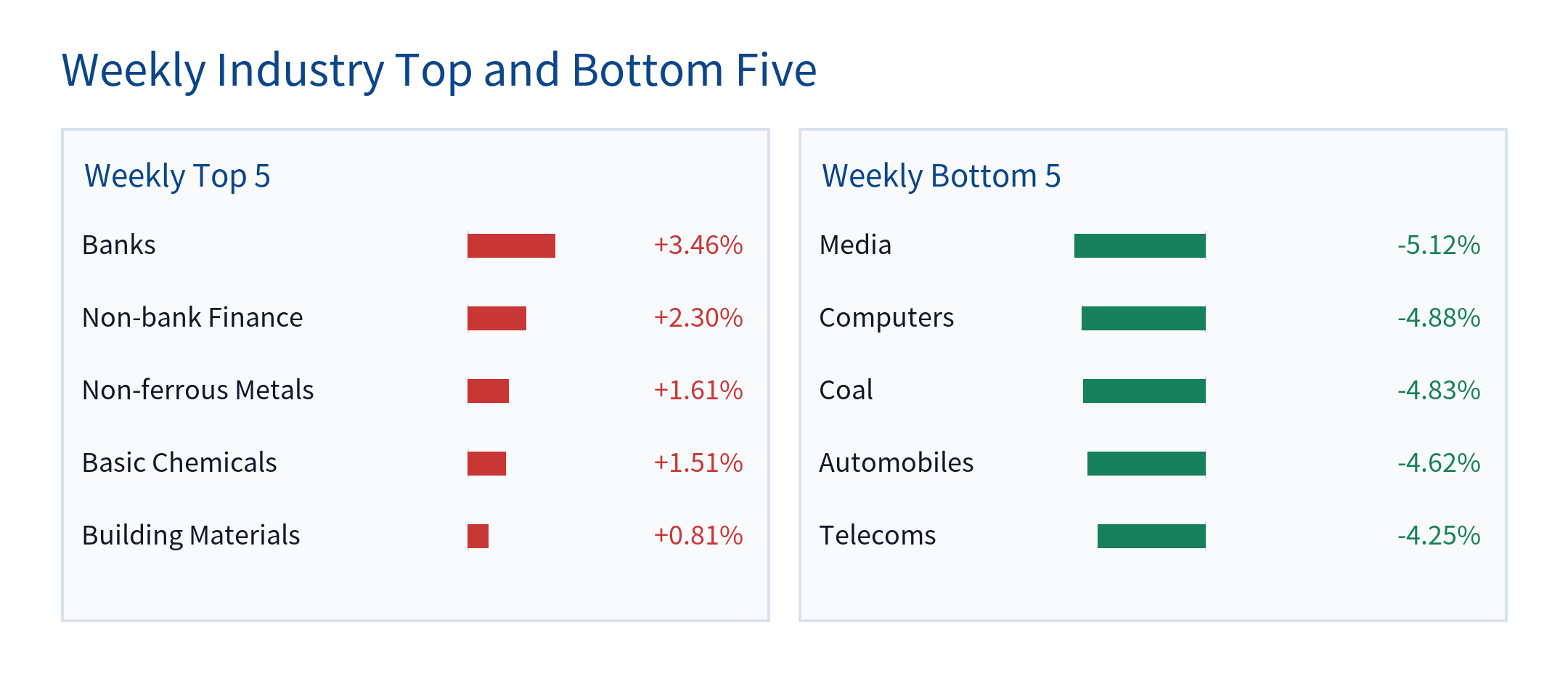
Prices and turnover changes aligned in some sectors but not fully. Basic chemicals rose +1.51%, with turnover up +15.34 hundred million yuan; non-ferrous metals rose +1.61%, with turnover up +8.98 hundred million yuan; banking rose +3.46%, with turnover up +2.76 hundred million yuan; non-bank financials rose +2.30%, with turnover up +1.89 hundred million yuan. IT fell -4.88% and communications -4.25%, with turnover falling -7.58 hundred million yuan and -7.83 hundred million yuan respectively. Yet machinery fell -3.61% despite turnover increasing +3.75 hundred million yuan. Activity changes can corroborate price strength in some sectors, but should not simply be treated as a uniform directional signal, and do not represent net inflows.
What to watch
Watch whether the numbers of rising sectors and those outperforming the benchmark improve from this week's 6 and 10 to assess participation. Watch the return gap between leaders and the median to track whether concentration persists or eases. Observe subsequent ranking changes in this week's reversal sectors, newly weak sectors and persistent laggards, and whether the relationship between prices and turnover changes continues.
Analyst's view
Last week's market research: after the Federal Reserve turns hawkish, technology remains central, but indices and stocks diverge further
Global markets showed clear selective moves last week. On the surface, Hong Kong, gold and some growth assets continued correcting after the Federal Reserve meeting. Flows, however, show the market was not weakening universally but concentrating further in a few strong industries. Individual-stock strength continued despite weak indices.
In A-shares, ChiNext and the STAR Market kept strengthening, with funds most concentrated in technology and growth. In Hong Kong, the Hang Seng and Hang Seng TECH Index broke key technical levels, with Thursday's close below 24000. Overall performance was weak, but AI hardware, PCB and semiconductor equipment remained active. US equities consolidated at high levels, with semiconductors and memory continuing as core index supports. Shanghai recovered more strongly, closing this week at 4090,
The biggest style feature last week was intensified divergence rather than a bull-to-bear transition. Funds kept moving from traditional industries towards technology and growth, and from weak to strong industry conditions.
Hong Kong equities: indices weaken as technology and traditional industries diverge sharply
Compared with US equities and A-shares, Hong Kong was among last week's weakest markets. The Hang Seng fell from 24718 to 23924, losing 794 points over the week and formally breaking below the key 24500 level. Technically, progressively lower highs and lows indicate an overall downtrend.
However, Hong Kong's internal structure matters more than the index itself. It is currently showing a typical pattern of weak indices and strong technology.
Simply put, silicon-based industries related to AI, computing and semiconductors keep attracting funds, while carbon-based industries such as consumption, property and traditional cyclicals keep underperforming.
A-shares: indices rise steadily as technology and growth retain the advantage
A-shares continued rebounding last week. Shanghai closed near 4090, while ChiNext and the STAR Market kept setting new highs for this rebound. Like Hong Kong, A-shares showed marked internal divergence.
Funds mainly concentrated in technology and growth areas such as computing, semiconductor equipment, memory and optical modules.
A-shares did not rise universally last week. Indices remained strong, but opportunities to make money were concentrated in a few core areas. This means the market has entered a phase of focusing less on indices and more on individual stocks.
Gold and crude oil: safe-haven premiums retreat as commodities enter a correction
Gold was weak last week. The Federal Reserve meeting's hawkish signal further reduced expectations of future cuts, supporting the dollar and Treasury yields and pressuring gold. The current focus is whether a double bottom can form near 4100 US dollars.
In the short term, gold lacks new catalysts and is more likely to consolidate. Longer term, central-bank gold buying, geopolitical risks and global debt expansion remain unchanged, so its long-term allocation rationale persists.
For crude oil, temporarily easing Middle East tensions led earlier risk premiums to unwind. Prices shifted from rapid rises to consolidation at high levels, with attention returning to supply and demand rather than geopolitics alone.
Risk warning
This report describes only the reporting-week data supplied and does not constitute investment advice. Weekly sector returns, rankings and trading-activity changes may reverse quickly. Turnover increases or decreases from last week reflect trading activity, not net inflows.